

An IT risk management framework is a structured system of principles, processes, and controls that helps an organization identify, assess, treat, and monitor technology risk. It gives teams a repeatable method for deciding which cyber and IT risks to fix, accept, or transfer, so security spending follows evidence instead of guesswork.
Every business faces the same core question: out of the hundreds of things that could go wrong with your technology, which ones actually deserve your budget and attention? An IT risk management framework is how you answer that without guessing. Three names dominate the conversation, and they are constantly confused with each other: NIST RMF, ISO 31000, and FAIR. This guide explains what a framework really is, then breaks down all three in plain English so you can see which one fits your business, or how to use them together.
- A framework is a repeatable method, not a checklist. Its job is to turn a chaotic pile of “what ifs” into a ranked, defensible list of risks to fix, accept, or transfer.
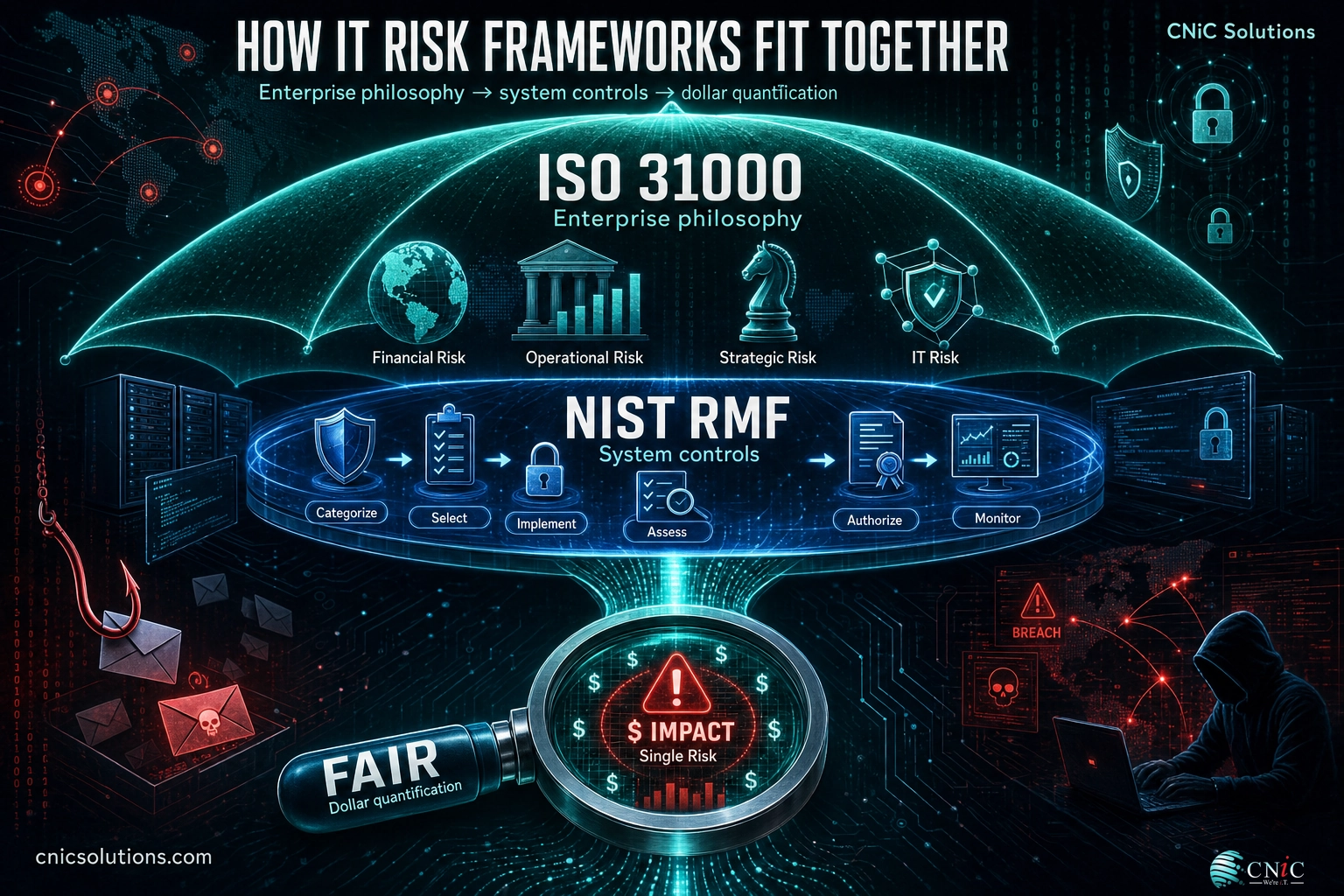
- The three leaders solve different problems. NIST RMF secures systems with prescriptive controls, ISO 31000 sets an enterprise-wide risk philosophy, and FAIR puts a dollar figure on individual risks.
- They are not mutually exclusive. Mature programs commonly run ISO 31000 as the umbrella, NIST for technical controls, and FAIR to quantify the risks that matter to leadership.
- NIST RMF is not the NIST Cybersecurity Framework. RMF (SP 800-37) is a seven-step, controls-heavy authorization process; the CSF is lighter, voluntary, outcome-based guidance.
- The payoff is financial. With the U.S. average data breach reaching $10.22 million in 2025, a framework is what keeps limited security dollars aimed at your largest exposures.
What’s in This Guide
What Is an IT Risk Management Framework?
An IT risk management framework is a structured, repeatable method for handling technology risk. Rather than reacting to threats one crisis at a time, it gives your organization a consistent way to find risks, judge how serious they are, decide what to do about each one, and keep watching them over time. The output is not a to-do list. It is a defensible set of decisions about where your limited security budget and effort should go.
Think of it like a doctor’s approach to a patient. A good physician does not order every test in the building or prescribe every drug on the shelf. They gather symptoms, weigh the likelihood and severity of each possible problem, treat what is most dangerous first, and schedule follow-ups to monitor the rest. A risk framework does exactly this for your technology. It stops you from spending heavily on unlikely threats while a serious, obvious gap sits unaddressed.
Almost every framework, no matter the name, moves through the same four core activities:
- Identify. Catalog what you are protecting (data, systems, people) and what could threaten it, from ransomware to a failed backup to a departing employee.
- Assess. Judge each risk by how likely it is and how much damage it would cause, then rank them so the biggest exposures rise to the top.
- Treat. Decide the response for each risk: reduce it with controls, transfer it (often through cyber insurance), accept it, or avoid the activity entirely.
- Monitor. Track the risks and controls continuously, because your systems, your threats, and your business all keep changing.
Where the frameworks differ is in how prescriptive they are, how wide they reach, and whether they measure risk in qualitative ratings (high, medium, low) or hard numbers. That difference is the whole reason three separate standards exist, and it is what determines which one fits your situation. Getting this foundation right is the same discipline behind a cybersecurity risk assessment: framework decides the method, and the assessment is the method applied to your actual environment.
Source: ISO 31000:2018 (ISO.org) | NIST’s official RMF overview
NIST RMF vs ISO 31000 vs FAIR: At a Glance
The single most common mistake is treating these three as competitors fighting for the same job. They are not. NIST RMF, ISO 31000, and FAIR operate at different levels and answer different questions. Before the deep dives, here is how they compare on the attributes that actually drive a decision.
| Attribute | NIST RMF | ISO 31000 | FAIR |
|---|---|---|---|
| Core purpose | Secure and authorize an information system with specific controls | Set an enterprise-wide philosophy for managing any risk | Quantify a specific risk in financial terms |
| Scope | IT and cybersecurity, system by system | All risk, organization-wide (financial, operational, strategic, IT) | Information and operational risk, one scenario at a time |
| Approach | Prescriptive: defined steps and control catalogs | Principles-based: flexible, tailored to your context | Quantitative: probability and dollar-loss modeling |
| Measures risk in | Qualitative impact levels (low, moderate, high) | Whatever method you choose (qualitative or quantitative) | Dollars (loss frequency times loss magnitude) |
| Best fit | Federal agencies, contractors, and control-heavy environments | Any organization wanting a unified risk approach | Teams that must justify risk and spend to executives |
| Published by | NIST (SP 800-37) | ISO (International Organization for Standardization) | The Open Group / FAIR Institute |
Read the table by column, and the relationship becomes clear. ISO 31000 is the widest and most flexible, a philosophy for risk of every kind. NIST RMF is the deepest and most prescriptive, built to lock down systems with named controls. FAIR is the sharpest and narrowest, a calculator that turns a single risk into a number a CFO can act on. That is why so many programs end up using more than one.
NIST RMF Explained
The NIST Risk Management Framework (RMF) is the most structured and prescriptive of the three. It was developed by the U.S. National Institute of Standards and Technology and is documented in NIST Special Publication 800-37, Revision 2. It is mandatory for U.S. federal agencies and their contractors, which is why it shows up constantly in defense, government, and regulated work. It is also fully usable by private businesses that want a rigorous, controls-based process.
RMF’s defining trait is that it does not just tell you to “assess risk.” It walks you through a seven-step lifecycle and points you to a specific control catalog (NIST SP 800-53) to protect each system. The seven steps run in order and then loop, because the final step feeds back into the others.
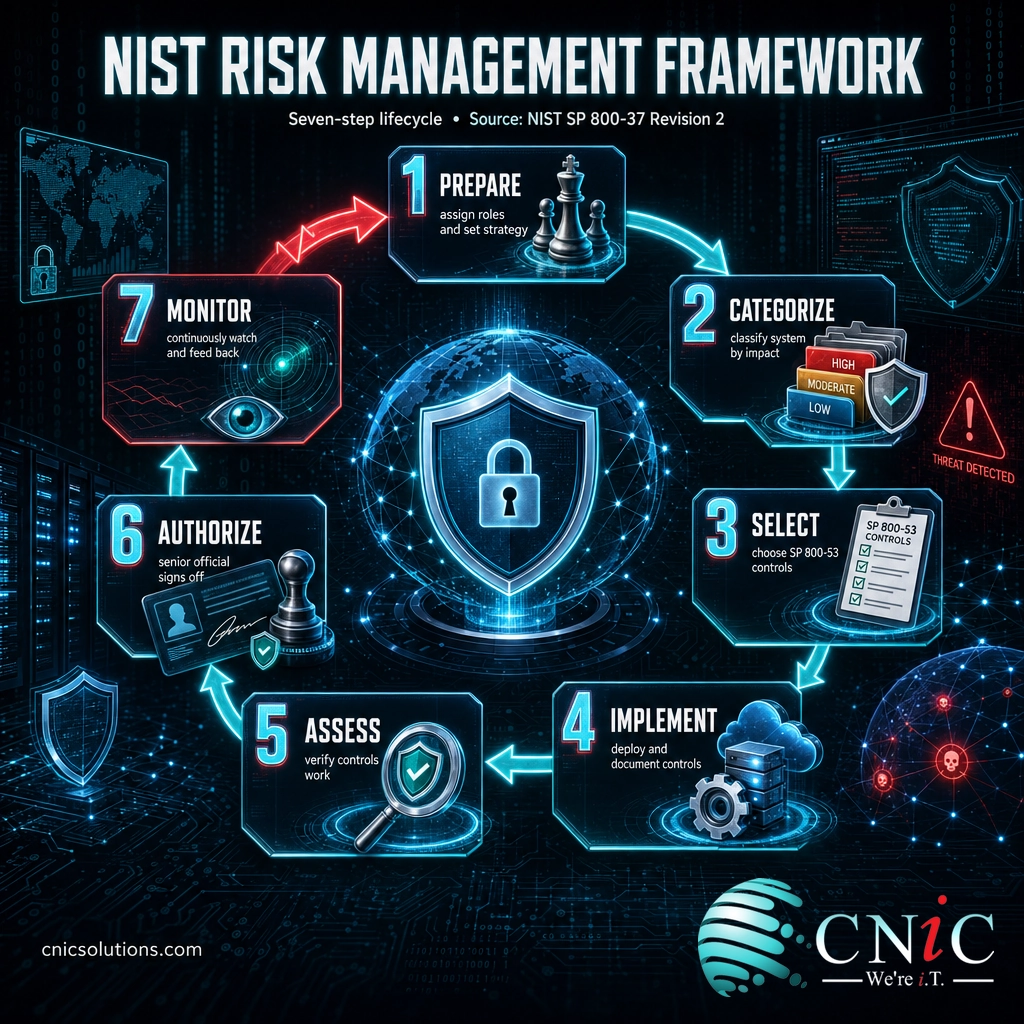
- Prepare. Get the organization ready to manage security and privacy risk by assigning roles, setting a risk strategy, and establishing context.
- Categorize. Classify the system and its data by the impact a loss of confidentiality, integrity, or availability would cause.
- Select. Choose the set of NIST SP 800-53 controls appropriate to that impact level and risk.
- Implement. Put the controls in place and document exactly how each one is deployed.
- Assess. Verify the controls are in place, working as intended, and producing the desired result.
- Authorize. A senior official makes a risk-based decision to formally authorize the system to operate.
- Monitor. Continuously watch the controls and the risk environment, feeding changes back into the earlier steps.
The strength of RMF is its rigor and repeatability. Nothing is left to interpretation, which is exactly what a regulated environment needs. The tradeoff is weight. Full RMF is resource-heavy and assumes you have people to run it, which is why it suits larger or compliance-driven organizations far better than a ten-person office. Smaller businesses often adopt the lighter NIST Cybersecurity Framework instead, then borrow RMF’s discipline where it counts.
Source: NIST Risk Management Framework overview | NIST SP 800-37 Rev. 2
ISO 31000 Explained
ISO 31000 sits at the opposite end of the spectrum from RMF. Published by the International Organization for Standardization and updated in 2018, it is a principles-based standard for managing risk of any kind, not just IT. Financial risk, operational risk, strategic risk, and cyber risk all live under the same roof. That breadth is the point: ISO 31000 is designed to be the single risk philosophy that runs across an entire organization.
Crucially, ISO 31000 does not hand you a control checklist. It gives you a way of thinking about risk that you then tailor to your own context. The standard is built on three connected components: a set of guiding principles, a framework for embedding risk management into governance and leadership, and a repeatable process for assessing and treating individual risks.
At its heart are eight principles that describe what good risk management looks like. Effective risk management is:
- Integrated into all organizational activities, not a side project
- Structured and comprehensive, applied consistently
- Customized to the organization’s context and objectives
- Inclusive of stakeholders and their perspectives
- Dynamic, anticipating and responding to change
- Based on the best available information
- Mindful of human and cultural factors
- Committed to continual improvement
The advantage of ISO 31000 is flexibility. It fits a two-person startup or a global enterprise, and it connects cyber risk to the broader business risks a leadership team already tracks. The tradeoff is that flexibility puts the work on you. Because it prescribes no specific controls, you have to translate its principles into concrete action, which is where a framework like NIST or a model like FAIR often gets bolted on underneath it.
Source: ISO 31000:2018 Risk management guidelines (ISO.org)

FAIR Explained
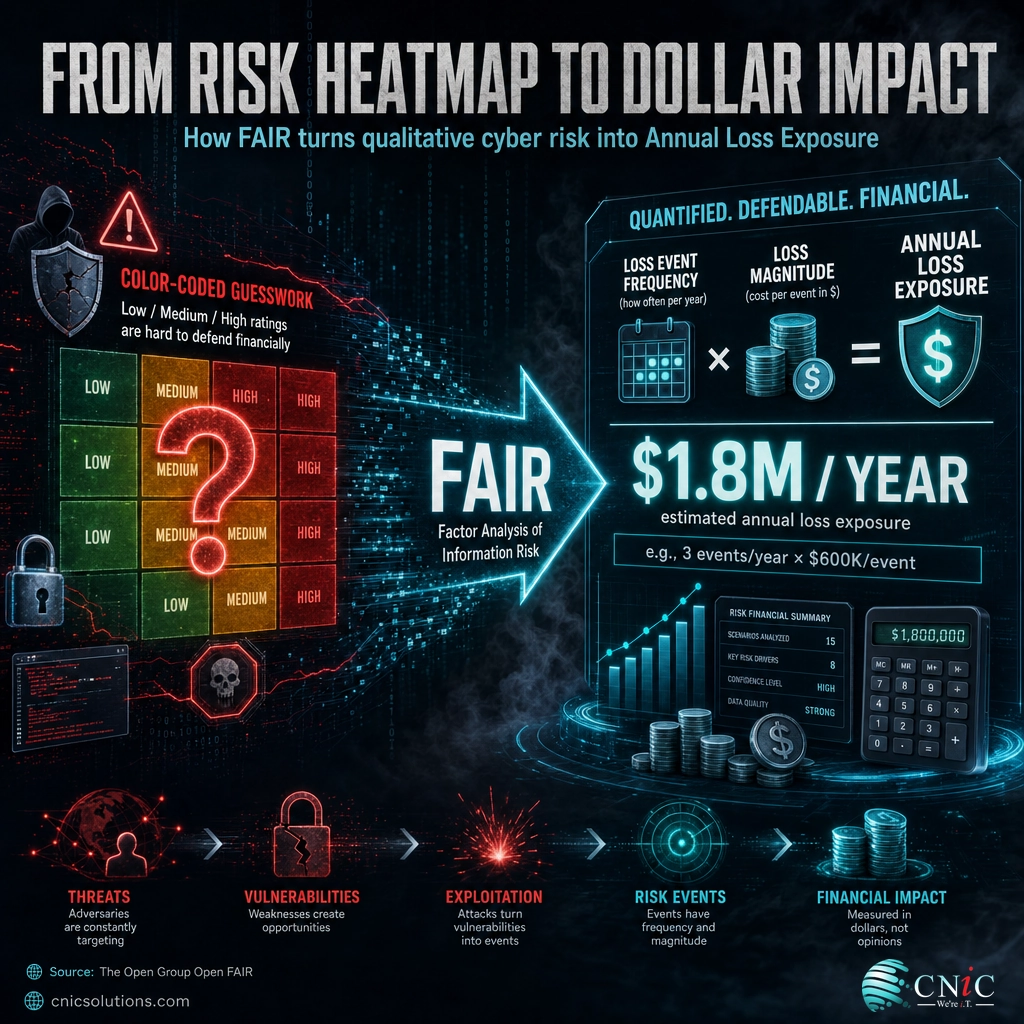
FAIR, short for Factor Analysis of Information Risk, answers a question the other two leave open: exactly how much money is this risk worth? Where NIST and ISO largely rate risk on qualitative scales (a red, amber, or green square on a heatmap), FAIR is a quantitative model that expresses risk in dollars. It is maintained as an open standard by The Open Group’s Open FAIR body of knowledge and championed by the FAIR Institute, and it is widely described as the only international standard model for quantifying information and operational risk in financial terms.
The core idea is simple even if the math gets detailed. FAIR calculates a risk as the combination of two things:
- Loss Event Frequency: how often a given loss event (say, a ransomware hit) is likely to happen in a year.
- Loss Magnitude: how much a single occurrence would cost, in real dollars, once you add up response, downtime, penalties, and reputation damage.
Multiply likelihood by impact, model the ranges, and you get a defensible dollar figure for loss exposure. That transforms the conversation with leadership. Instead of telling a CFO a risk is “high,” you can say a particular scenario carries an estimated annual loss exposure of, for example, $1.2 million, and that a $150,000 control would cut it in half. Suddenly a security investment is a business decision with a return, not an act of faith.
FAIR’s strength is that it speaks the language of the boardroom and forces rigor into what is often hand-waving. Its limitation is that it is a measurement model, not a full program: it tells you how to quantify a risk, not which controls to deploy or how to govern the whole effort. That is precisely why FAIR is usually layered on top of ISO 31000 or NIST rather than used alone. This kind of financial framing is a core reason businesses lean on strategic IT leadership to connect security spending to measurable outcomes.
Source: The Open Group, Open FAIR standard | FAIR Institute, What is FAIR
NIST CSF vs NIST RMF: Clearing Up the Confusion
Because NIST publishes more than one document with “framework” in the name, the single biggest mix-up in this whole topic is confusing the Risk Management Framework (RMF) with the NIST Cybersecurity Framework (CSF). They are related but genuinely different tools, and choosing the wrong one for your business wastes real time.
| Attribute | NIST RMF (SP 800-37) | NIST Cybersecurity Framework (CSF) |
|---|---|---|
| What it is | A prescriptive process to secure and authorize a system | Voluntary, outcome-based guidance for managing cyber risk |
| Structure | Seven sequential steps plus a control catalog (SP 800-53) | Six functions: Govern, Identify, Protect, Detect, Respond, Recover |
| Mandatory? | Yes, for federal agencies and many contractors | No, voluntary for all organizations |
| Feels like | A detailed compliance procedure | A flexible roadmap of goals to reach |
| Best for | Regulated, control-heavy environments | Businesses of any size building a security program |
The short version: CSF tells you what good cybersecurity outcomes look like, while RMF prescribes how to implement controls and formally sign off on a system. Most small and midsize businesses are far better served starting with the CSF. If you want a deeper walkthrough of that specific standard, we cover it in detail in our guide to the NIST Cybersecurity Framework.
Source: NIST Cybersecurity Framework (NIST.gov)
Why a Framework Matters for Your Business
It is fair to ask whether a formal framework is worth the effort for a company that is not a bank or a federal contractor. The answer comes down to money and defensibility. A framework is what keeps a limited security budget pointed at your biggest exposures, and it is what lets you prove, to an insurer, an auditor, or a client, that your decisions were deliberate rather than lucky.
The stakes are set by the cost of getting it wrong. In IBM’s 2025 Cost of a Data Breach report, the global average breach cost was $4.44 million, but the figure for U.S. organizations climbed to $10.22 million, driven by regulatory penalties and slower detection. Breaches also take a long time to control: organizations needed an average of 241 days to identify and contain one.
Average Cost of a Data Breach, 2025 (IBM)
Global breach costs eased year over year, but the U.S. average reached a record $10.22 million. Source: IBM Cost of a Data Breach 2025.
A framework does not make those numbers disappear, but it changes your odds. By forcing you to identify and rank exposures, it ensures the control you can afford is spent on the risk most likely to produce a seven-figure loss, not the one that happens to be top of mind that week.
There is also a compliance dividend. The same identify-assess-treat-monitor discipline that a framework enforces is what most regulations and cyber insurers now expect to see documented. Building it once tends to satisfy several obligations at once, which is why we treat it as the backbone of broader IT compliance requirements for small and midsize businesses.
Myth: adopting a framework means picking one and abandoning the others. This is the most expensive misconception in risk management. The three leaders are not rivals; they operate at different altitudes. A common, effective pattern uses ISO 31000 as the enterprise-wide philosophy, NIST RMF or CSF to implement and govern technical controls, and FAIR to put a dollar figure on the specific risks leadership needs to decide about. Forcing a single framework to do all three jobs is what leaves programs either too rigid or too vague.
Source: IBM Cost of a Data Breach Report 2025
How to Choose and Get Started
You do not need to master all three frameworks to begin. You need to match your starting point to your situation and build from there. Use this as a practical guide:
- Start with the NIST Cybersecurity Framework if you are a small or midsize business building your first structured security program. It scales to any size, needs no federal mandate, and its six functions give you an approachable roadmap.
- Reach for ISO 31000 if you want one risk philosophy that connects cyber risk to financial, operational, and strategic risk across the whole company, especially if leadership already thinks in enterprise-risk terms.
- Adopt full NIST RMF if you are a federal contractor, handle regulated data, or operate in an environment that demands prescriptive, auditable controls system by system.
- Add FAIR when you need to justify security spending to executives in dollars, prioritize a shortlist of major risks, or defend a budget with numbers instead of colors.
Whichever you choose, the first move is the same: run an honest assessment of what you have, what you are protecting, and where the real gaps are. That baseline is what any framework builds on, and it is where the biggest early wins usually hide. For most businesses, the fastest path is to work with a partner who has run these frameworks before, so you inherit the method instead of learning it during your first audit.
Get a Free Security Assessment
Build a Risk Program With a Virtual CIO
Common Questions
What is an IT risk management framework?
What is the difference between NIST RMF, ISO 31000, and FAIR?
Is NIST RMF the same as the NIST Cybersecurity Framework?
Which risk management framework is best for a small business?
Can you use more than one framework at once?
Related Terms
- NIST Cybersecurity Framework (CSF): voluntary, outcome-based guidance organized around six functions for managing cyber risk, and the lighter alternative to full NIST RMF for most businesses.
- Cybersecurity risk assessment: the hands-on exercise of applying a framework to your actual systems to find and rank real exposures.
- IT governance: the leadership structures and policies that make sure technology decisions, including risk decisions, support business goals.
- Risk appetite: the amount and type of risk an organization is willing to accept in pursuit of its objectives, set by leadership.
- Risk treatment: the choice of how to respond to a risk: mitigate it with controls, transfer it (often via insurance), accept it, or avoid it.
- SP 800-53: the NIST catalog of security and privacy controls that NIST RMF draws on during its Select and Implement steps.
- Cyber risk quantification: expressing risk in financial terms, the discipline FAIR is built to deliver. See the real numbers in our data breach cost statistics.
- Compliance audits (SOC): the attestations that prove your controls work, where a documented risk framework pays off. Learn the difference between SOC 1 and SOC 2.
About This Guide
Framework definitions and structures are drawn from their primary standards bodies: NIST for the Risk Management Framework (SP 800-37, Rev. 2) and the Cybersecurity Framework, the International Organization for Standardization for ISO 31000:2018, and The Open Group and FAIR Institute for FAIR. Breach cost and containment figures are from IBM’s 2025 Cost of a Data Breach report. Figures are cited to their original sources and used to illustrate why structured risk management matters, not as guaranteed outcomes for any specific business.
Sources: NIST RMF | NIST SP 800-37 Rev. 2 | ISO 31000:2018 | The Open Group, Open FAIR | FAIR Institute | NIST Cybersecurity Framework | IBM Cost of a Data Breach 2025
Talk to CNiC About Managing Your IT Risk



related posts
Microsoft 365 Business Premium vs Office 365 E3: Which Is Right for…
September 20, 2026Here is the short answer most buyers do not expect: Microsoft 365 Business Premium costs less…
McAfee Scam Emails: How to Spot Fake Renewal Notices
September 20, 2026A fake McAfee renewal email is one of the most common scams landing in business inboxes…
Managed Services Statistics: Market Size, Growth, and Adoption Data
September 19, 2026The global managed services market is on track to pass $430 billion in 2026, and by…
Malware Statistics for 2026: Volume, Variants, and the Shift to Malware-Free Attacks
September 19, 2026Security vendors now track more than 1.5 billion known malware samples, and the AV-TEST Institute registers…