

The NIST Cybersecurity Framework is the closest thing the security world has to a shared language for managing cyber risk. It does not sell you a product or hand you a checklist to tick off. Instead, it gives any organization, of any size, a structured way to answer four questions that matter: what are we protecting, what could go wrong, how well are we handling it today, and where do we need to be. This guide explains what the framework is, how its six functions, four tiers, and profiles fit together, how it differs from the often-confused NIST Risk Management Framework, and the practical steps to put it to work in a real business without a large security team.
Key Takeaways
- The NIST CSF is a risk framework, not a rulebook. It describes cybersecurity outcomes to achieve, then lets you decide how to reach them, which is why it fits businesses of every size and sector.
- Version 2.0 added a sixth function: Govern. Released in February 2024, CSF 2.0 elevated leadership, strategy, and oversight to the center of the framework, alongside Identify, Protect, Detect, Respond, and Recover.
- The Core is deep but navigable. Six functions break down into 22 categories and 106 subcategories, giving you a granular map of outcomes without prescribing specific tools.
- Tiers measure maturity, not merit. The four implementation tiers describe how consistent your risk management is. The right target depends on your risk and resources, not a race to Tier 4.
- Profiles turn the framework into a plan. Comparing a Current Profile with a Target Profile produces a prioritized, defensible list of the gaps that matter most.
- CSF is not the RMF. The Cybersecurity Framework is a voluntary strategic map; the Risk Management Framework is a formal seven-step process for authorizing federal systems.
- It unifies your other obligations. Because CSF outcomes map to ISO 27001, CIS Controls, HIPAA, and PCI-DSS, the framework works as an umbrella that ties compliance efforts together.
What’s in This Guide
- What the NIST Cybersecurity Framework Is and Why It Exists
- How the Framework Manages Risk: Core, Tiers, and Profiles
- The Six Functions of NIST CSF 2.0
- Implementation Tiers: Measuring How Mature Your Risk Management Is
- Profiles: Turning the Framework into a Plan
- NIST CSF vs. NIST RMF: Clearing Up the Confusion
- How NIST CSF Maps to Your Other Frameworks
- How to Adopt NIST CSF: A Step-by-Step Path
- Common Mistakes When Adopting the Framework
- What to Do Next: Implementation Roadmap
- NIST CSF 2.0 at a Glance
- Related Resources
- Frequently Asked Questions
1What the NIST Cybersecurity Framework Is and Why It Exists
The NIST Cybersecurity Framework, usually shortened to CSF, is voluntary guidance published by the National Institute of Standards and Technology, part of the U.S. Department of Commerce. Its job is narrow and useful: to help an organization understand its cybersecurity risk and reduce it in a deliberate, repeatable way. It does that not by telling you which firewall to buy, but by describing the outcomes a sound security program produces, then leaving the how to you. That single design choice is why the same framework works for a hospital network, a manufacturer, a law firm, and a ten-person accounting practice.
The framework was born out of a practical problem. In 2013, Executive Order 13636 directed NIST to work with industry and develop a common approach to protecting critical infrastructure. The first version, CSF 1.0, arrived in February 2014. Version 1.1 followed in 2018, refining supply chain guidance and self-assessment. In February 2024, NIST published CSF 2.0, the most significant update yet, broadening the framework’s audience from critical infrastructure to organizations of every kind and adding governance as a first-class concern.
It helps to be precise about what the framework is and is not. It is a risk-management tool, a communication tool, and an organizing structure. It is not a law, not a certification you pass or fail, and not a product. You do not become “NIST certified” the way you might achieve an ISO 27001 certificate. Instead, you adopt the framework, measure yourself against it, and use the results to prioritize. That distinction shapes everything that follows in this guide.
Why has a voluntary framework become so influential? Because it filled a gap that everyone felt. Before the CSF, a small business owner asking “am I doing enough?” had no neutral yardstick, and two vendors could describe the same risk in completely different terms. The framework gave leaders, technical teams, auditors, regulators, and insurers a shared vocabulary. When a cyber-insurance application asks whether you have an asset inventory, an incident response plan, and tested backups, it is asking, in plain words, about CSF outcomes. Building your program around the framework means you are already speaking the language your stakeholders use.
The breadth of who relies on the framework is part of why it carries weight. It is used by Fortune 500 security teams and by two-person startups, by hospitals and school districts, by manufacturers and law firms, and by government agencies at every level. That range is possible only because the framework describes outcomes instead of prescribing implementations. A large enterprise and a small practice can both aim to achieve the outcome “authorized users, devices, and other assets are managed consistent with risk,” even though the tools and effort behind that outcome look nothing alike. The framework meets each organization where it is, which is exactly what a business without a dedicated security department needs from a starting point.
There is a second reason it matters for smaller organizations specifically. Cyber risk is no longer proportional to company size. Attackers automate, and they favor targets with thinner defenses. Framing security as risk management, rather than a pile of disconnected tools, is what lets a resource-constrained business spend its limited budget where it actually reduces the most risk. A formal cybersecurity risk assessment is often the first concrete step organizations take when they decide to adopt the framework in earnest.
Source: NIST Cybersecurity Framework | NIST CSF 2.0 official publication
2How the Framework Manages Risk: Core, Tiers, and Profiles
People often reduce the NIST CSF to its list of functions, but the framework actually has three distinct components that work together. Understanding how they relate is the key to using the framework well rather than treating it as a poster on the wall. The three parts are the Core, the Implementation Tiers, and the Profiles.
The Core is the catalog of cybersecurity outcomes, organized into functions, categories, and subcategories. It answers the question “what should a good security program actually accomplish?” The Core is descriptive: it names outcomes such as “asset inventories are maintained” or “incident response plans are executed,” without dictating the technology you use to get there.
The Implementation Tiers describe how rigorously and consistently your organization manages cyber risk, on a scale from Partial to Adaptive. They are a lens for judging maturity, not a scorecard where higher is always better. A small firm with modest risk may rationally choose to operate at a middle tier rather than pour resources into reaching the top.
The Profiles are where the framework becomes personal to your business. A Profile is a snapshot of which Core outcomes you are achieving and how well. By creating a Current Profile of where you stand and a Target Profile of where you need to be, you produce a gap analysis that turns abstract guidance into a concrete, prioritized plan.
The simplest way to hold all three in your head: the Core is the map of everything a security program can do, the Tiers are a ruler for how consistently you do it, and the Profiles are your route from where you are to where you need to be. Every practical use of the framework is some combination of these three, and none of them requires you to buy a specific product to begin.
A quick worked example makes it concrete. Suppose a professional-services firm decides to adopt the framework. It uses the Core to review each outcome and honestly rate itself, discovering that it detects threats poorly and has no tested recovery plan. It uses the Tiers to recognize that its overall approach is still largely “Partial,” reacting to problems rather than anticipating them. It then sets a Target Profile that raises detection and recovery to a defined, repeatable standard, and the gap between current and target becomes its security roadmap for the year. No jargon, no wasted spend, just a clear line from assessment to action.
Source: NIST CSF 2.0 official publication
3The Six Functions of NIST CSF 2.0
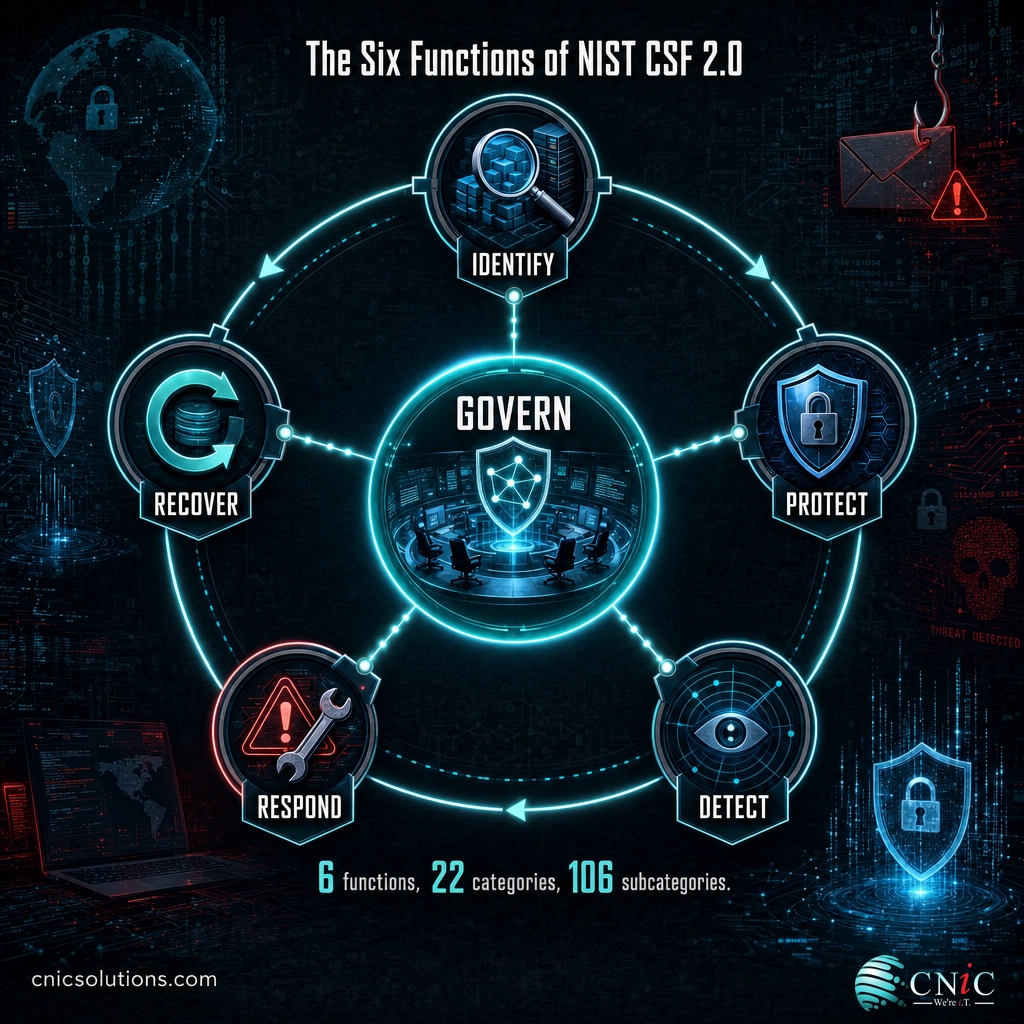
The functions are the part of the framework most people picture first, and for good reason. They are the highest level of the Core, and they organize everything else. CSF 2.0 defines six functions. The first, Govern, is new in version 2.0 and represents the biggest change from the earlier five-function model. It does not run in sequence with the others; it wraps around them, informing every decision. The remaining five describe a continuous operational loop.
Govern (GV): the new center of the framework
Govern establishes and monitors the organization’s cybersecurity risk-management strategy, expectations, and policy. It covers the things that are easy to overlook when security is treated as a purely technical problem: who owns risk decisions, how much risk the business is willing to accept, how roles and responsibilities are assigned, how policy is set, and how supply chain risk is managed. By adding Govern, NIST made explicit what mature organizations already knew, that cybersecurity is a leadership responsibility, not something delegated entirely to the IT closet.
The Govern function is also the largest single addition to the Core, accounting for 31 subcategories on its own. That heft signals intent: strategy and oversight are not an afterthought sitting above the “real” security work, they are the foundation the other five functions rest on. This is the outcome area where a Virtual CIO or virtual CISO adds the most value for a business that has no executive dedicated to technology risk.
Identify (ID): know what you are protecting
You cannot protect what you cannot see. The Identify function is about developing an understanding of the assets, data, systems, suppliers, and risks that make up your environment. It includes maintaining an inventory of hardware and software, classifying the data you hold, mapping how information flows, and assessing where your risks concentrate. Nearly every organization that struggles with security is really struggling with Identify: they are defending a perimeter they have never fully mapped.
Protect (PR): put safeguards in place
Protect covers the safeguards that limit or contain the impact of a potential event. This is where the familiar controls live: identity and access management, multi-factor authentication, least-privilege permissions, data encryption, secure configuration, patch and vulnerability management, and workforce security awareness training. Protect is usually the largest area of day-to-day security spending, and the framework’s value here is ensuring that spending is driven by identified risk rather than by whichever product a vendor sold you last.
Detect (DE): find events quickly
Detect is about finding potentially adverse events in a timely way. It includes continuous monitoring, log collection and analysis, and the ability to recognize anomalies and indicators of compromise. Detection is where under-resourced organizations most often fall short, because it requires ongoing attention rather than a one-time purchase. The gap between “we were breached” and “we noticed we were breached” is a detection gap, and it is frequently measured in months.
Respond (RS): act on incidents
Respond covers the actions taken once an incident is detected: executing an incident response plan, communicating with stakeholders, analyzing the event, containing and eradicating the threat, and capturing lessons learned. A written, tested response plan is the single most valuable Respond outcome, because the middle of a crisis is the worst possible time to decide who does what. Organizations with rehearsed plans consistently contain incidents faster and at lower cost.
Recover (RC): restore operations
Recover is about restoring the assets and operations affected by an incident and returning to normal business. It centers on resilience: reliable, tested backups, documented recovery procedures, and clear communication during restoration. Recover is where business continuity meets cybersecurity, and it is the function that determines whether an incident is a bad week or an existential event. The subtle failure point here is untested backups. Many organizations believe they can recover because a backup job runs every night, only to discover during a real incident that the backups are incomplete, corrupted, or take days to restore. The Recover function exists to force that assumption into the open before an attacker does. Dependable data backup and recovery is the operational backbone of this function, and regular restore testing is what turns a backup into genuine resilience.
Make Recover real with tested backup and disaster recovery
| Function | Code | Core Question | Representative Outcomes |
|---|---|---|---|
| Govern | GV | Who owns risk, and what is our strategy? | Risk strategy, roles, policy, oversight, supply chain risk |
| Identify | ID | What do we have, and what could go wrong? | Asset inventory, data classification, risk assessment |
| Protect | PR | How do we prevent and limit harm? | Access control, MFA, encryption, patching, training |
| Detect | DE | How do we know something is wrong? | Monitoring, logging, anomaly detection |
| Respond | RS | What do we do when it happens? | Incident response plan, communication, containment |
| Recover | RC | How do we get back to normal? | Tested backups, recovery procedures, resilience |
Beneath these six functions, the Core drills down into more granular detail. Each function contains categories, which are grouped outcomes, and each category contains subcategories, which are specific, measurable results. In total, CSF 2.0 organizes cybersecurity into 22 categories and 106 subcategories. That structure is what lets you move from a boardroom conversation about “governance” all the way down to a specific, auditable outcome, without losing the thread.
The structure of the CSF 2.0 Core, by level of detail
Source: NIST Cybersecurity Framework (CSF) 2.0, February 2024
Build a security program around the six NIST functions
Source: NIST CSF 2.0 official publication | NIST Cybersecurity Framework resources
4Implementation Tiers: Measuring How Mature Your Risk Management Is
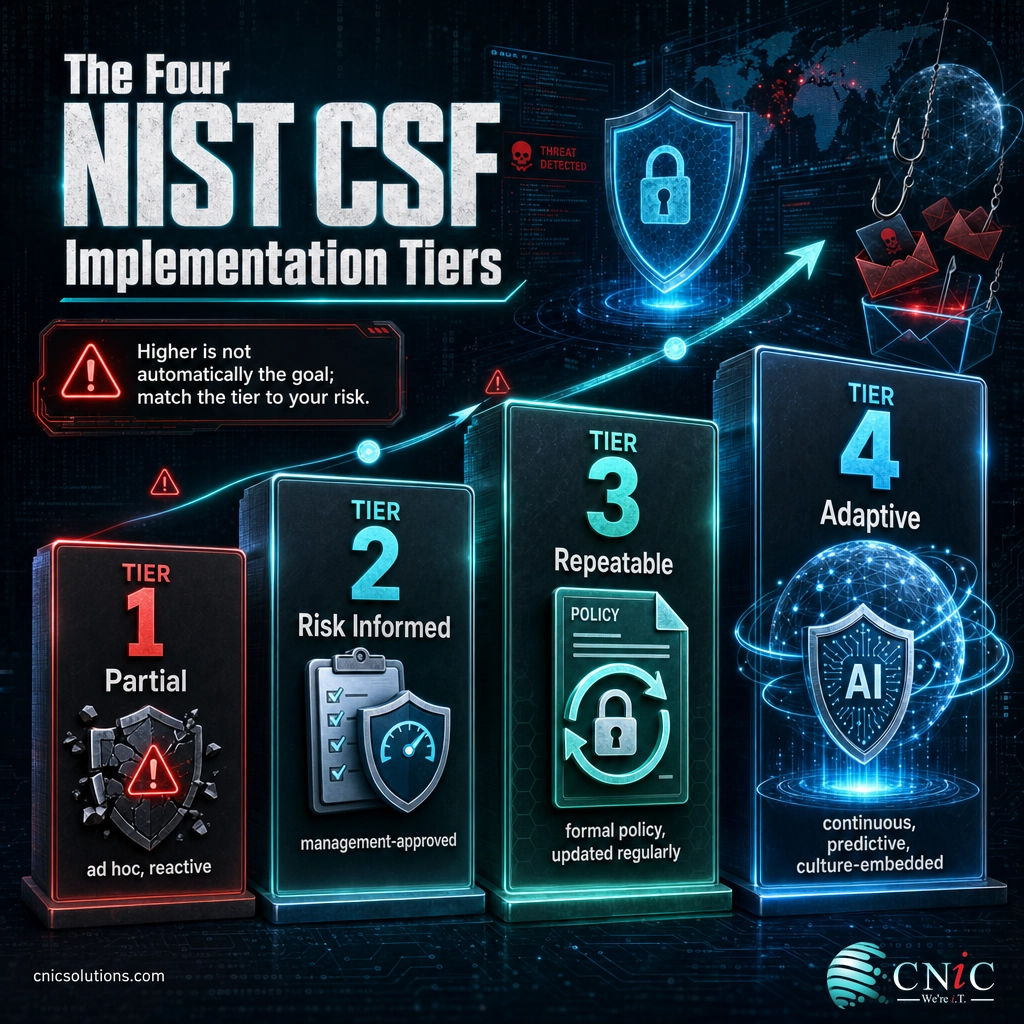
If the functions describe what a security program does, the implementation tiers describe how well it does it. The framework defines four tiers that characterize the rigor, consistency, and adaptiveness of an organization’s cybersecurity risk-management practices. They range from Tier 1, where security is ad hoc and reactive, to Tier 4, where risk management is continuous and woven into the culture.
The most important thing to understand about the tiers is that they are not a grading system where everyone should sprint toward Tier 4. NIST is explicit that the appropriate tier depends on an organization’s risk tolerance, threat environment, legal and regulatory requirements, and resources. A boutique firm handling low-sensitivity data may make a perfectly sound decision to target Tier 2, while a healthcare business or defense contractor may need Tier 3 or higher. Choosing a target tier is a business decision, and it belongs in the Govern function.
| Tier | Name | What It Looks Like | Typical Fit |
|---|---|---|---|
| Tier 1 | Partial | Risk is managed ad hoc and reactively; limited awareness; little organization-wide coordination. | Early-stage or very low-risk operations |
| Tier 2 | Risk Informed | Risk-management practices are approved by management but may not be established as organization-wide policy. | Growing businesses formalizing security |
| Tier 3 | Repeatable | Practices are formally approved, expressed as policy, and updated regularly based on changes in risk. | Regulated or contract-driven businesses |
| Tier 4 | Adaptive | The organization adapts practices based on lessons learned and predictive indicators; security is part of the culture. | High-risk or high-obligation organizations |
In practice, a business rarely sits neatly at one tier across every function. It is common to be Tier 3 on Protect, because tools and policies are in place, while languishing at Tier 1 on Detect and Recover, because monitoring and backup testing get neglected. That unevenness is useful information. It tells you exactly where maturity is lagging and where the next dollar of security investment will do the most good. Reaching a higher tier is less about buying more and more about doing what you do consistently, with documented ownership and regular review.
Source: NIST CSF 2.0 official publication
5Profiles: Turning the Framework into a Plan
The Core tells you what good looks like and the Tiers tell you how consistent you are, but the Profiles are what turn the framework from a reference document into a working plan for your specific business. A Profile is a selection of the Core outcomes, tailored to your mission, requirements, risk appetite, and resources. Put plainly, it is the framework filtered down to what matters for you.
The framework uses two kinds of Profile in tandem. A Current Profile documents the cybersecurity outcomes your organization is achieving today, and how well. A Target Profile documents the outcomes you need to be achieving, given your risks and obligations. The distance between the two is your gap analysis, and that gap analysis is the most valuable artifact the framework produces.
Current Profile plus Target Profile equals your roadmap. When you lay the two side by side, subcategory by subcategory, the differences are not vague concerns anymore. They are a specific, rankable list: “we have no tested backups,” “access reviews are not performed,” “there is no incident response plan.” That list, sorted by risk, is your security roadmap. Everything else is execution.
CSF 2.0 expanded the idea of profiles in a helpful way. Alongside the organizational profiles a single business builds for itself, NIST now provides Community Profiles, which are shared baselines developed for a particular sector, technology, or challenge. A community profile gives a business a credible starting Target Profile drawn from peers with similar risks, instead of a blank page. For a small or midsize organization, that shortcut removes one of the biggest barriers to getting started, which is deciding what “good enough” should mean for a company like yours.
Profiles are also how you make the framework defensible to outsiders. When a cyber insurer, an auditor, or an enterprise client asks how you manage risk, a documented profile with a dated gap analysis and a remediation plan is a far stronger answer than a verbal assurance. It shows not just that you have controls, but that you understand your risk and are managing it deliberately. That evidence trail is exactly what a mature IT compliance program for a small business is built to produce.
Source: NIST Cybersecurity Framework resources
6NIST CSF vs. NIST RMF: Clearing Up the Confusion
No pair of NIST publications gets confused more often than the Cybersecurity Framework (CSF) and the Risk Management Framework (RMF). The names are similar, both deal with managing cyber risk, and both come from NIST, so people use them interchangeably. They are not interchangeable, and knowing the difference saves a lot of wasted effort, especially for businesses that touch government work.
The Cybersecurity Framework is the flexible, voluntary structure this guide has described. It is outcome-based, scalable to any organization, and designed for communication and prioritization. You adopt it by choice, tailor it with profiles, and use it to organize a risk-based program. There is no pass or fail.
The Risk Management Framework, defined primarily in NIST Special Publication 800-37, is a formal, mandatory process used by U.S. federal agencies and their contractors to authorize information systems to operate. It is prescriptive and detailed, built around a repeatable seven-step process: Prepare, Categorize, Select, Implement, Assess, Authorize, and Monitor. Where the CSF asks “what outcomes should we achieve?”, the RMF asks “has this specific system met the required controls well enough to be formally authorized?”
| Dimension | NIST Cybersecurity Framework (CSF) | NIST Risk Management Framework (RMF) |
|---|---|---|
| Primary source | NIST CSF 2.0 (CSWP 29) | NIST SP 800-37, with SP 800-53 controls |
| Nature | Voluntary, flexible guidance | Mandatory, prescriptive process |
| Primary users | Any organization, any size | Federal agencies and their contractors |
| Structure | Functions, tiers, and profiles | A seven-step system authorization process |
| Question it answers | What outcomes should our program achieve? | Is this system authorized to operate? |
| Best thought of as | A strategic map for managing risk | A rigorous compliance process for systems |
The myth worth retiring: that a small business “needs to do the NIST RMF” to be secure. Unless you are handling federal information systems, the RMF is almost certainly not your framework. Chasing its seven-step authorization process would burn resources on formality your business does not need. For the vast majority of private companies, the Cybersecurity Framework is the right tool, and its profiles give you all the rigor you need without the federal overhead. Match the framework to your obligations, not to whichever acronym sounds more thorough.
The two are not enemies, and they can coexist. A defense contractor might use the CSF to run its overall security program and communicate with leadership, while following the RMF for the specific government systems that require formal authorization. But for a typical small or midsize business, the practical takeaway is simple: start with the CSF, and reach for the RMF only if a government contract explicitly requires it.
Source: NIST Risk Management Framework overview | NIST CSF 2.0 official publication
7How NIST CSF Maps to Your Other Frameworks
One of the most practical strengths of the NIST CSF is that it was never meant to stand alone. It is deliberately designed to sit above and connect the other frameworks and regulations a business already faces. Rather than being one more standard competing for attention, the CSF works as an umbrella that ties your obligations together into a single, coherent picture of risk.
NIST supports this directly through informative references, which are published cross-mappings that connect each CSF subcategory to the corresponding controls in other standards. Because those mappings exist, the work you do to satisfy one framework counts toward the others. An access-control outcome you implement for the CSF is the same outcome an auditor is looking for under ISO 27001, a CIS Control, or a HIPAA Security Rule requirement. The overlap is the whole point.
| Framework or Regulation | What It Is | How the CSF Relates |
|---|---|---|
| ISO/IEC 27001 | International standard for an information security management system | CSF outcomes map closely to ISO controls; many use CSF to prepare for ISO certification |
| CIS Critical Security Controls | Prioritized, prescriptive list of defensive actions | CIS Controls are a concrete way to achieve many CSF Protect and Detect outcomes |
| HIPAA Security Rule | Federal safeguards for protected health information | CSF provides a structure for organizing and evidencing HIPAA safeguards |
| PCI-DSS | Payment card industry data security standard | CSF outcomes align with PCI control areas such as access, encryption, and monitoring |
| SOC 2 | Attestation on service-organization trust criteria | A CSF-based program produces much of the evidence SOC 2 auditors request |
This is why so many organizations adopt the CSF first and let it drive everything else. Instead of running five parallel compliance projects, you build one risk-based program organized by the CSF functions, then use the informative references to demonstrate how that single program satisfies each specific obligation. It reduces duplicated effort, and it gives leadership one consolidated view of risk instead of a stack of disconnected audit reports.
For a business already juggling several regulations, the framework’s mapping ability is often the single most compelling reason to adopt it. It converts a chaotic obligation list into an ordered program. Our overview of the wider IT compliance and regulatory landscape walks through how these individual rules interlock in more detail.
Source: NIST Cybersecurity Framework resources
8How to Adopt NIST CSF: A Step-by-Step Path
Reading about the framework is easy; adopting it is where organizations stall. The good news is that a workable adoption path is genuinely straightforward, and you do not need to complete all 106 subcategories on day one. The goal of a first pass is to understand your risk and produce a prioritized plan, then improve on a repeating cycle. Here is the path most businesses follow.
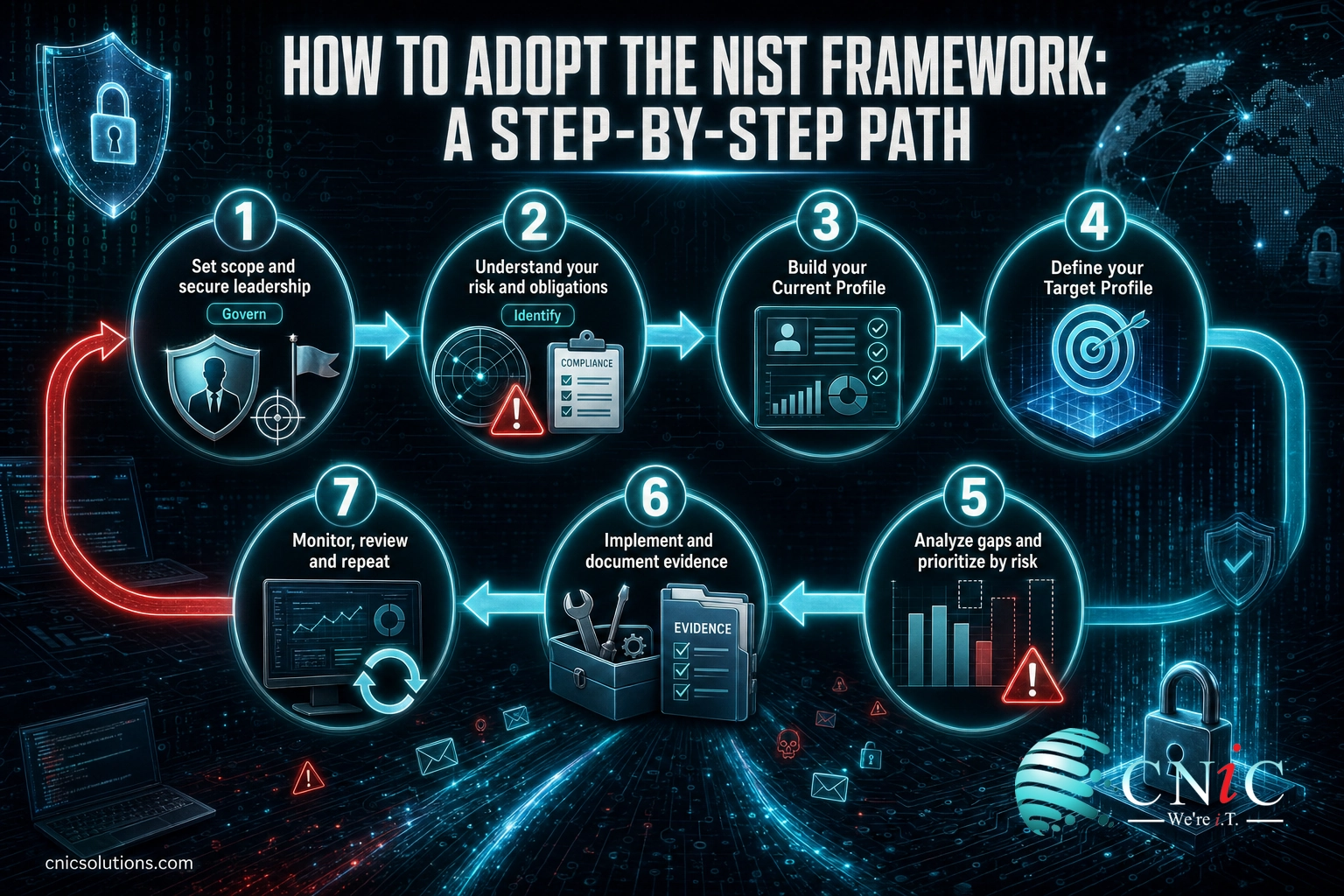
Step 1: Set the scope and prioritize with leadership
Start in the Govern function. Decide what part of the business the effort covers, confirm your risk tolerance, name who owns the initiative, and secure leadership buy-in. Scope creep and unclear ownership are the two most common reasons framework projects fizzle, so nail these down first.
Step 2: Understand your risk and obligations
Identify your assets, data, and the legal, regulatory, and contractual requirements that apply to you. This is the Identify function in action. A structured risk assessment here prevents you from building a program that protects the wrong things while ignoring your real exposure.
Step 3: Build your Current Profile
Rate how you are handling each relevant CSF outcome today, honestly. The temptation is to grade generously; resist it. An inflated Current Profile produces a comfortable report and a program that leaves real risk unaddressed. The value is in the truthful picture.
Step 4: Define your Target Profile
Decide where you need to be, informed by your risk, your obligations, and, if one exists for your sector, a NIST Community Profile. This is where you set your target implementation tier for each area, so the goal is explicit rather than assumed.
Step 5: Analyze the gaps and prioritize
Lay the Current and Target Profiles side by side and list the differences. Sort that list by risk, not by ease. The highest-risk gaps, not the easiest ones, are where you begin. This ranked list is the heart of your plan.
Step 6: Implement, and document as you go
Work the plan, closing gaps in priority order. Crucially, document what you do as you do it. In security, the control and the evidence that the control exists are two different deliverables, and auditors, insurers, and clients want the second one. Undocumented work effectively did not happen.
Step 7: Monitor, review, and repeat
The framework is a cycle, not a project. Monitor your controls, review the profile on a set schedule and after major changes, and feed what you learn back into the next iteration. The Govern function keeps this loop alive so your risk posture keeps pace with the business.
When to bring in help: a business with in-house security expertise can run this cycle on its own. Many small and midsize organizations do not have that expertise, and that is exactly the gap a managed IT and security partner fills, providing the assessment, the profile work, the documentation discipline, and the ongoing monitoring that the framework assumes. If your team is stretched thin, an outside partner turns the framework from a document you admire into a program you actually run.
Get managed IT support to run your NIST program
Source: NIST Cybersecurity Framework resources | CISA cybersecurity best practices
9Common Mistakes When Adopting the Framework
The framework is forgiving, but a handful of predictable mistakes turn a useful exercise into a wasted one. Knowing them in advance is the cheapest insurance you can buy.
The first is treating the framework as a checklist to complete once. The CSF is a cycle. An organization that produces a profile, files it, and never revisits it drifts out of alignment as systems and threats change, usually discovering the drift at the worst moment. Build the review cadence in from the start.
The second is chasing Tier 4 for its own sake. Higher tiers cost real money and effort, and they are not the goal for every business. Spending toward Tier 4 on outcomes that do not warrant it starves the areas that actually carry your risk. Let your risk assessment, not ambition, set your target.
The third is skipping the Govern function. It is tempting for technical teams to jump straight to Protect and Detect, the parts that feel like “real” security. Without ownership, strategy, and policy from Govern, those controls lack direction and tend to decay. NIST put Govern at the center of 2.0 precisely because programs without it underperform.
The fourth is confusing having controls with proving them. Implementing MFA is worth little to an auditor or insurer if you cannot show it is enforced everywhere and maintained. Documentation is not busywork; in a review, it is the deliverable.
The fifth, and most costly for smaller organizations, is trying to do everything alone with no security expertise on staff. The framework assumes someone knows how to assess risk, interpret outcomes, and maintain the program. If no one in the building has that skill, the honest move is to bring in a partner rather than produce a profile that looks complete but rests on guesswork.
Source: NIST CSF 2.0 official publication
What to Do Next: Implementation Roadmap
If you are ready to put the framework to work, the actions below sequence the effort from first move to ongoing habit. Priority reflects where most businesses get the greatest risk reduction earliest.
| Action | Priority | Timeline | Relevant Service |
|---|---|---|---|
| Secure leadership ownership and set scope (Govern) | Critical | Week 1 | Virtual CIO / vCISO |
| Run a cybersecurity risk assessment (Identify) | Critical | Weeks 1–3 | Cybersecurity services |
| Build your Current Profile against the CSF Core | High | Weeks 2–4 | Cybersecurity services |
| Set a realistic Target Profile and target tiers | High | Week 4 | Virtual CIO / vCISO |
| Prioritize gaps by risk and build the action plan | High | Weeks 4–5 | Managed IT services |
| Close highest-risk gaps and document evidence | Ongoing | Months 1–6 | Managed IT services |
| Harden Recover: tested backups and DR procedures | High | Months 1–3 | Data backup and recovery |
| Monitor, review on schedule, and iterate | Ongoing | Continuous | Managed IT services |
Start with a Virtual CIO to own your risk strategy
NIST CSF 2.0 at a Glance
The reference table below consolidates the framework’s key building blocks in one place, from the six functions through the tiers, profiles, and how it differs from the RMF.
| Element | Type | What It Means |
|---|---|---|
| Govern (GV) | Function | Risk strategy, roles, policy, oversight, and supply chain risk; new in 2.0 |
| Identify (ID) | Function | Understand assets, data, suppliers, and risks |
| Protect (PR) | Function | Safeguards: access control, MFA, encryption, patching, training |
| Detect (DE) | Function | Monitoring, logging, and anomaly detection |
| Respond (RS) | Function | Incident response, communication, and containment |
| Recover (RC) | Function | Restore operations with tested backups and resilience |
| Framework Core | Component | 6 functions, 22 categories, 106 subcategories of outcomes |
| Implementation Tiers | Component | Tier 1 Partial to Tier 4 Adaptive; measures maturity, not merit |
| Current Profile | Component | How you handle each outcome today |
| Target Profile | Component | How you need to handle each outcome |
| Gap analysis | Output | Difference between current and target; your roadmap |
| Community Profile | Component | Shared baseline for a sector or challenge |
| Informative references | Feature | Cross-mappings to ISO 27001, CIS, HIPAA, PCI, and more |
| Tier 1 — Partial | Tier | Ad hoc, reactive risk management |
| Tier 2 — Risk Informed | Tier | Management-approved practices, not yet organization-wide |
| Tier 3 — Repeatable | Tier | Formal policy, updated regularly |
| Tier 4 — Adaptive | Tier | Continuous, predictive, culture-embedded |
| CSF (CSWP 29) | Publication | Voluntary, flexible framework for any organization |
| RMF (SP 800-37) | Publication | Mandatory seven-step process for federal systems |
| Released February 2024 | Milestone | CSF 2.0, the current version of the framework |
Related Resources
From CNiC Solutions:
- What a cybersecurity risk assessment is and why you need one — the Identify-function starting point for framework adoption.
- IT compliance for SMBs: the complete guide — how framework-based programs produce audit-ready evidence.
- Navigating the IT compliance and regulatory landscape — the individual rules the CSF helps you unify.
- The IT compliance checklist for small business — a practical companion to your Target Profile.
- Cybersecurity compliance statistics for 2026 — the data behind why risk management pays off.
Authoritative external references:
- NIST Cybersecurity Framework — the official hub and resource library.
- NIST CSF 2.0 (CSWP 29) — the full framework publication.
- NIST Risk Management Framework — the RMF for federal systems.
- CISA cybersecurity best practices — practical implementation guidance.
Frequently Asked Questions
What is the NIST Cybersecurity Framework?
What are the six functions of NIST CSF 2.0?
Is the NIST Cybersecurity Framework the same as the NIST Risk Management Framework?
Is the NIST Cybersecurity Framework mandatory?
How do the NIST CSF implementation tiers work?
How does a small business start using the NIST framework?
How does NIST CSF relate to frameworks like ISO 27001 and CIS Controls?
How often should we update our NIST CSF profile?
Methodology and Sources
This guide summarizes the structure and intended use of the NIST Cybersecurity Framework version 2.0 and distinguishes it from the NIST Risk Management Framework. All framework structural details, including the six functions, 22 categories, 106 subcategories, four implementation tiers, and the profiles model, are drawn from the official NIST publication. The seven-step Risk Management Framework process is drawn from NIST Special Publication 800-37, Revision 2. No statistics in this article are estimated or invented; every figure describes the framework’s own published structure and is attributable to a primary NIST source.
Primary sources: NIST, The NIST Cybersecurity Framework (CSF) 2.0 (CSWP 29), February 2024; NIST Cybersecurity Framework program resources (nist.gov/cyberframework); NIST Special Publication 800-37, Revision 2, Risk Management Framework for Information Systems and Organizations; CISA cybersecurity best practices.
Last Updated: August 2026



related posts
McAfee Scam Emails: How to Spot Fake Renewal Notices
September 20, 2026A fake McAfee renewal email is one of the most common scams landing in business inboxes…
Microsoft 365 Business Premium vs Office 365 E3: Which Is Right for…
September 20, 2026Here is the short answer most buyers do not expect: Microsoft 365 Business Premium costs less…
Managed Services Statistics: Market Size, Growth, and Adoption Data
September 19, 2026The global managed services market is on track to pass $430 billion in 2026, and by…
Malware Statistics for 2026: Volume, Variants, and the Shift to Malware-Free Attacks
September 19, 2026Security vendors now track more than 1.5 billion known malware samples, and the AV-TEST Institute registers…