

Data governance is the framework of policies, roles, and processes that controls how an organization collects, stores, uses, and protects its data. It keeps data accurate, secure, and compliant by defining who is accountable for each type of data and what they are allowed to do with it.
Your business runs on data it may not fully control. Customer records, financial files, employee information, and contracts sit across email, laptops, shared drives, and cloud apps, often with no clear owner and no agreed rules. Data governance is what replaces that sprawl with structure. It answers the questions most companies cannot: who owns this data, who is allowed to touch it, is it accurate, and how long do we keep it? Get those answers right and data becomes an asset you can trust. Get them wrong and it becomes a liability that shows up as bad decisions, failed audits, and breaches.
- Governance is about accountability, not software. At its core, data governance assigns ownership and rules to your data so that accuracy, security, and compliance have a named owner rather than falling through the cracks.
- Bad data is expensive. Gartner estimates poor data quality costs organizations an average of $12.9 million every year, a direct tax on decisions made from unreliable information.
- You cannot protect what you cannot see. IBM found more than one third of data breaches involved shadow data held in unmanaged sources, and breaches spanning multiple environments cost more than $5 million on average.
- Governance is not just for enterprises. Any business holding customer, financial, or health data has data to govern. Small and midsize companies start lean and expand.
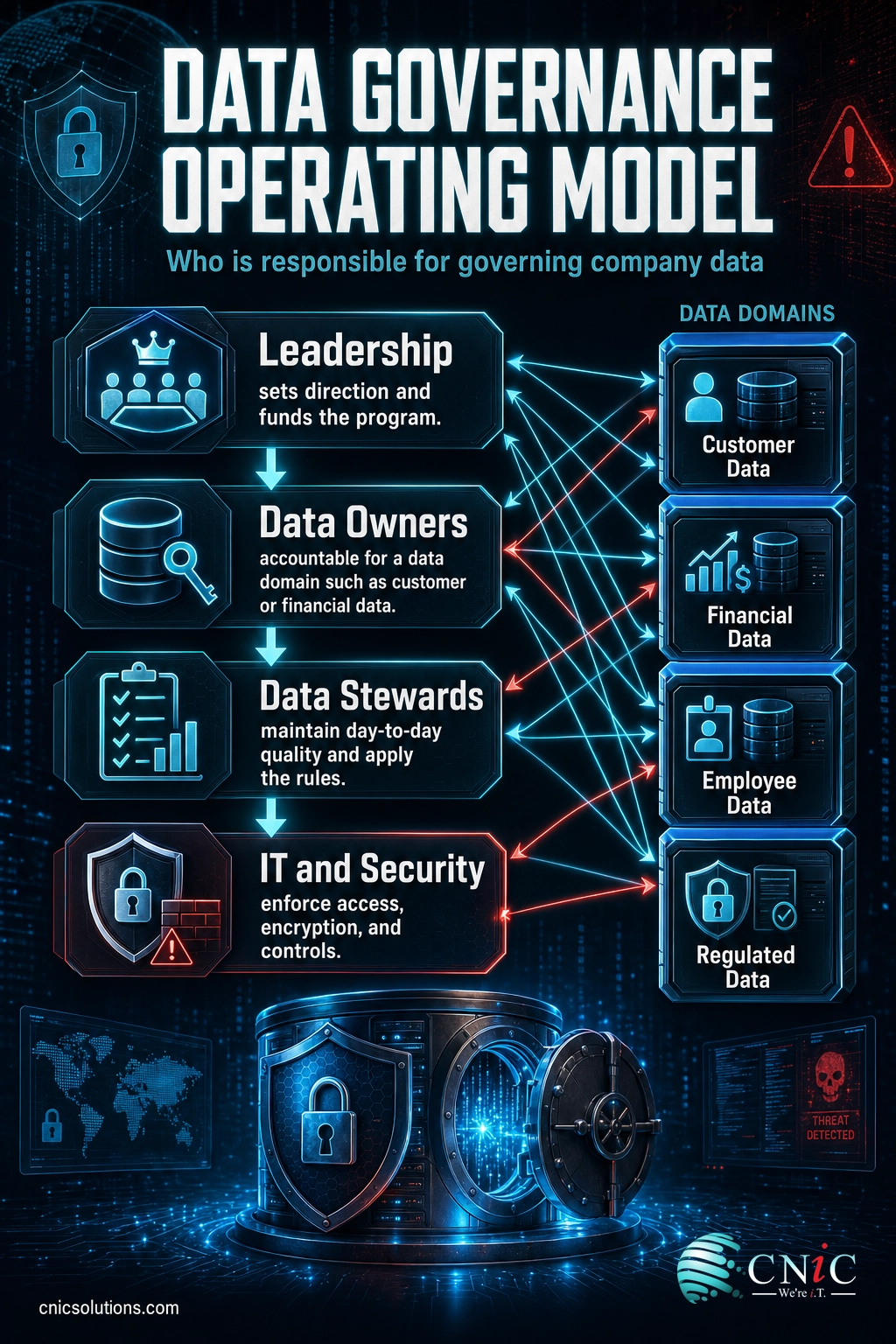
- It is a shared responsibility. Leadership funds it, data owners are accountable, stewards maintain quality, and IT enforces the controls, often coordinated by a CIO or Virtual CIO.
What’s in This Guide
What Is Data Governance?
Data governance is the set of policies, roles, and processes an organization uses to manage its data as a controlled, trustworthy asset. It establishes who has authority over each type of data, what standards that data must meet, and how decisions about it get made. The international standard for the subject, the ISO/IEC 38505-1 standard for the governance of data, frames it as applying clear direction, evaluation, and monitoring to how an organization uses its data, so that use stays aligned with the goals and obligations of the business.
A useful way to picture it is traffic management for a city. The cars are your data, moving constantly between departments, systems, and partners. Without traffic lights, lane markings, and rules of the road, you get gridlock and accidents. Data governance is that system of signals and rules. It does not drive the cars, but it decides how they move, who has the right of way, and what happens when something goes wrong. The goal is not control for its own sake. It is to make sure the right people can use the right data, safely, and trust that it is correct.
Governance is distinct from the tools that store or analyze data. You can buy the best database, security platform, or analytics suite on the market and still have chaos if no one has agreed who owns customer data, what “active client” actually means, or how long invoices are retained. Governance is the human and organizational layer that makes the technology meaningful. That is also why it is treated as a professional discipline with its own body of knowledge, maintained by groups such as DAMA International through its Data Management Body of Knowledge.
Source: ISO/IEC 38505-1, Governance of data | DAMA International, DAMA-DMBOK
The Core Components of Data Governance
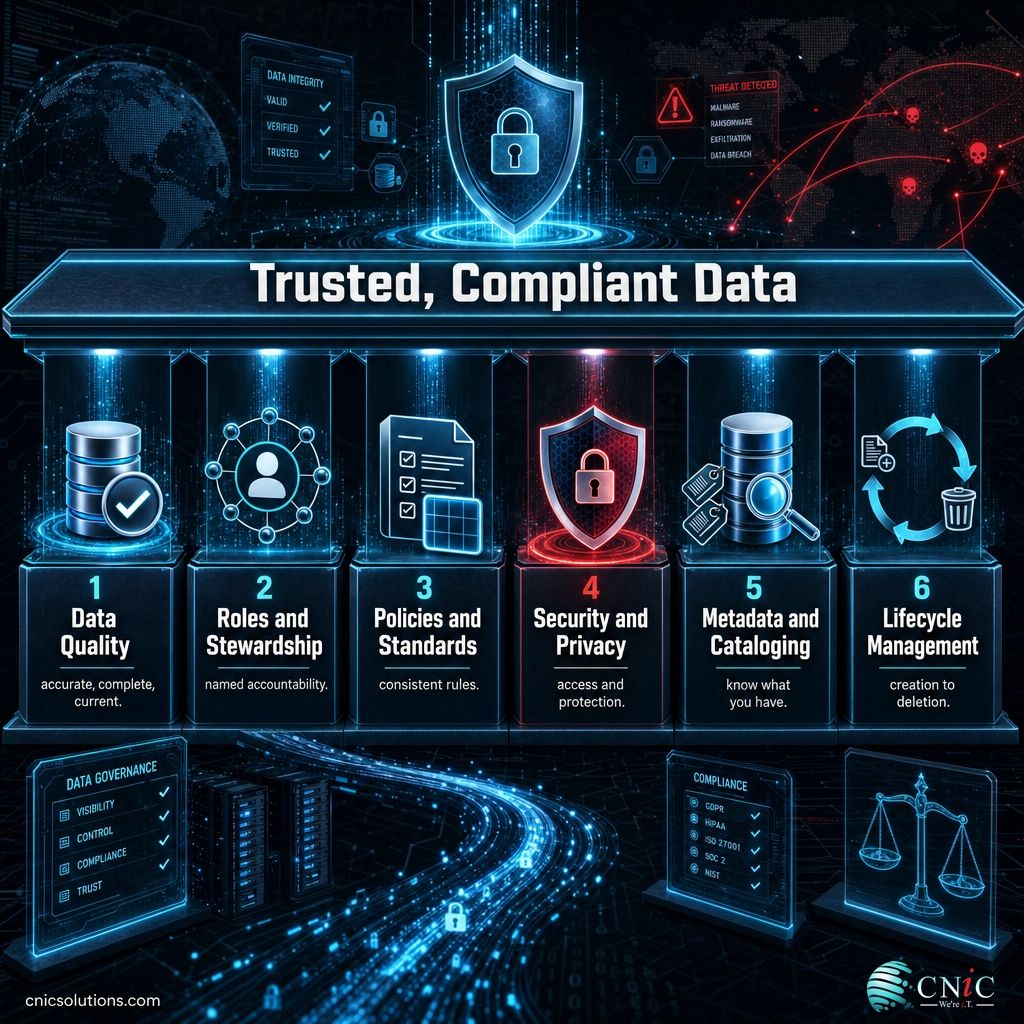
Data governance is not a single activity. It is a small number of connected disciplines that together make data trustworthy and accountable. A program does not need all of them on day one, but every mature program covers these six.
- Data quality. The rules and checks that keep data accurate, complete, consistent, and current. This is the foundation, because every downstream decision inherits the quality of the data beneath it.
- Roles and stewardship. Named accountability. Data owners are senior people accountable for a domain such as customer or financial data, while data stewards handle the day-to-day work of maintaining quality and applying the rules.
- Policies and standards. The written rules that define how data is named, classified, entered, shared, and approved, so the same term means the same thing across every department.
- Security and privacy. The controls that decide who can access what, and how sensitive and regulated data is protected. This is where governance connects directly to the NIST Privacy Framework and to obligations like HIPAA and PCI-DSS.
- Metadata and cataloging. Knowing what data you have and where it lives. A data catalog and clear metadata turn a pile of files into an inventory you can actually manage.
- Lifecycle management. Governing data from creation through use, sharing, archiving, and eventual deletion, including how long each type is kept. This is where a formal data retention policy does its work.
These components reinforce each other. Strong metadata makes quality checks possible. Clear roles make policies enforceable. Lifecycle rules keep the security surface from growing endlessly as old data piles up. Weak governance usually means one or two of these exist informally while the rest are missing, which is exactly where accuracy and compliance start to slip.
Source: NIST Privacy Framework | DAMA International, DAMA-DMBOK

Data Governance vs. Data Management
The single most common point of confusion is the line between data governance and data management. The two are related but not the same, and mixing them up leads businesses to buy tools when what they actually lack is rules. The simplest distinction: governance decides what should happen and who is accountable, while management is the execution that carries it out.
| Attribute | Data Governance | Data Management |
|---|---|---|
| Focus | Rules, roles, and accountability | Hands-on execution and operations |
| Core question | What should we do with this data, and who decides? | How do we store, move, and secure it? |
| Typical work | Setting policy, defining owners, classifying data, approving standards | Databases, integration, backups, access provisioning, analytics |
| Owned by | Leadership, data owners, stewards, a governance council | IT and data engineering teams |
| Output | Policies, roles, accountability, and standards | Working systems and maintained data |
Think of it as the difference between a building code and a construction crew. The building code (governance) sets the standards every structure must meet and who signs off. The crew (management) does the physical work to those standards. You need both. A crew with no code builds inconsistently and unsafely, and a code with no crew is just paper. In practice, good governance makes management easier, because the team executing knows exactly which rules to follow.
Source: DAMA International, DAMA-DMBOK
Why Data Governance Matters for Your Business
Governance can sound like an abstract, enterprise concern until you translate it into money and risk. Three numbers make the business case concrete, and all three get worse the longer data goes ungoverned.
First, ungoverned data is usually low-quality data, and low-quality data is expensive. When customer records are duplicated, product data is inconsistent, and no one is accountable for fixing it, every report and forecast built on that data is quietly wrong. Gartner has estimated the average annual cost of this problem across organizations.
Second, governance is a front-line defense against breaches, because you cannot protect data you do not know you have. The IBM Cost of a Data Breach report puts the global average cost of a breach at $4.88 million, and its findings point straight at governance gaps. More than a third of breaches involved “shadow data,” information sitting in unmanaged sources that governance is supposed to bring under control, and breaches involving data spread across multiple environments, such as a mix of on-premises systems and business cloud platforms, cost the most of all.
Third, governance is what makes compliance provable. Regulations such as HIPAA, PCI-DSS, and state privacy laws do not just ask you to protect data. They ask you to show who can access it, how it is classified, and how long it is retained. That evidence only exists if governance created it. This is why data governance underpins any serious IT compliance effort, and why an auditor’s first questions are usually governance questions.
Myth: data governance is only for large enterprises. The opposite is often true. A regulated small business handling patient or cardholder data carries the same legal obligations as a large one, but with fewer people to absorb a mistake. The difference is scale, not need. A five-person medical office still has to know where protected health information lives, who can see it, and how long it is kept. Skipping governance does not make the obligation disappear. It just means no one is accountable for it until something goes wrong.
Explore Managed Cybersecurity Services
See Backup and Recovery Options
Source: Gartner data and analytics governance research | IBM Cost of a Data Breach Report
Types of Data Governance Models
There is no single way to run governance. The right model depends on the size of the business, how it is structured, and how strict its regulatory environment is. Most programs fall into one of three operating models, plus a choice of posture.
1Centralized Governance
A single team or authority sets and enforces the rules for the whole organization. This gives maximum consistency and is common in heavily regulated businesses where uniformity is non-negotiable. The tradeoff is that it can be slow and can feel disconnected from the departments doing the daily work.
2Decentralized or Federated Governance
Individual departments or business units govern their own data within a shared, lightweight set of company-wide standards. This model is faster and more responsive to each team’s needs, and it scales well, but it requires strong coordination to prevent the standards from drifting apart. Most growing midsize businesses land here.
3Hybrid Governance
A central group owns the core policies, classifications, and security standards, while departments handle execution for their own domains. This is the most common practical model because it balances consistency with speed, keeping the non-negotiable rules central while pushing day-to-day stewardship out to the people closest to the data.
Cutting across all three is a choice of posture. Traditional, command-and-control governance imposes strict rules from the top down and works best in highly regulated settings. A lighter, non-invasive approach formalizes the good data habits people already have and assigns accountability without adding heavy bureaucracy, which tends to succeed in smaller organizations where a rigid program would just be ignored. The best model is the one your team will actually follow.
How to Get Started With Data Governance
You do not launch data governance with a giant, company-wide program. You start small, prove value, and expand. For most small and midsize businesses, a workable first version follows five steps.
- Find and classify your data. Identify what data you hold and where it lives, then sort it by sensitivity: public, internal, confidential, and regulated. You cannot govern what you have not inventoried, and this step alone often surfaces the shadow data that drives breach risk.
- Assign ownership. Give each important data domain a named owner and, where needed, a steward. Accountability is the single most important ingredient, and it costs nothing but a decision.
- Write a few clear policies. Start with the rules that matter most: access, classification, acceptable use, and retention. A short policy people follow beats a long one they ignore.
- Put controls behind the policies. Translate rules into enforcement, such as access permissions, encryption for sensitive data, and reliable backups so governed data can be recovered.
- Review and expand. Governance is ongoing, not a one-time project. Review quality, access, and retention on a set schedule and widen coverage as the business grows. Aligning that cadence with a broader technology plan keeps it from stalling.
The hardest part is rarely the technology. It is the ownership and the discipline to keep it going, which is why many businesses assign overall direction to a CIO or, if they lack one internally, an outsourced Virtual CIO who can set the strategy, translate regulations into practical rules, and hold the program accountable over time. Pairing that leadership with a formal cybersecurity risk assessment gives you a clear, prioritized starting point rather than a blank page.
Common Questions About Data Governance
What is data governance in simple terms?
What is the difference between data governance and data management?
What are the main components of data governance?
Do small businesses need data governance?
Who is responsible for data governance?
Related Terms
- Data management: the hands-on execution of storing, integrating, securing, and maintaining data according to the rules governance sets.
- Data steward: the person responsible for the day-to-day quality and correct handling of a specific set of data.
- Data retention policy: the rules that define how long each type of data is kept and when it is securely deleted, a core part of lifecycle governance.
- IT compliance: meeting the legal and regulatory obligations that governance produces the evidence for, from HIPAA to PCI-DSS.
- Business associate agreement: a HIPAA contract that governs how a vendor may handle protected health data on your behalf. Learn what a business associate agreement requires.
- SOC 2: an independent attestation that a service organization has sound controls over data, closely tied to governance evidence. See how SOC 1 and SOC 2 reports differ.
- Metadata: the descriptive information about your data (what it is, where it came from, who owns it) that makes a data catalog possible.
- Data quality: the measure of how accurate, complete, consistent, and current your data is, and the first thing governance sets out to protect.
About This Guide
Definitions of data governance are grounded in the ISO/IEC 38505-1 international standard for the governance of data and DAMA International’s Data Management Body of Knowledge (DAMA-DMBOK), the recognized professional reference for the field. The security and privacy component references the NIST Privacy Framework. The cost of poor data quality is Gartner’s published estimate. Breach cost figures, including the average breach cost and the impact of shadow data and multi-environment data, are from the IBM Cost of a Data Breach Report 2024, produced with the Ponemon Institute. Figures are cited to their original sources and used to illustrate the business case for governance, not as guaranteed outcomes for any specific organization.
Sources: ISO/IEC 38505-1, Governance of data | DAMA International, DAMA-DMBOK | NIST Privacy Framework | Gartner data and analytics governance research | IBM Cost of a Data Breach Report 2024



related posts
OKRs vs. KPIs: What’s the Difference?
September 22, 2026An OKR (Objective and Key Results) is a goal-setting framework that pairs an ambitious objective with…
Password Statistics for 2026: Reuse, Cracks, and the Passkey Shift
September 22, 2026Weak and stolen passwords are still the number one way attackers get in. In 2025, stolen…
15 Microsoft Teams Tips and Tricks to Boost Team Productivity
September 21, 2026Microsoft Teams is where most of the workday now happens: it passed 320 million monthly active…
Mobile Security Software for Business: A Buyer’s Guide
September 21, 2026Choosing mobile security software for business comes down to two decisions: how you will manage the…