

Network segmentation is the practice of dividing a computer network into smaller, isolated zones and controlling the traffic allowed between them. It limits how far an attacker, a piece of malware, or a technical fault can spread, which makes it one of the most effective and lowest-cost ways to contain a security incident before it reaches your whole business.
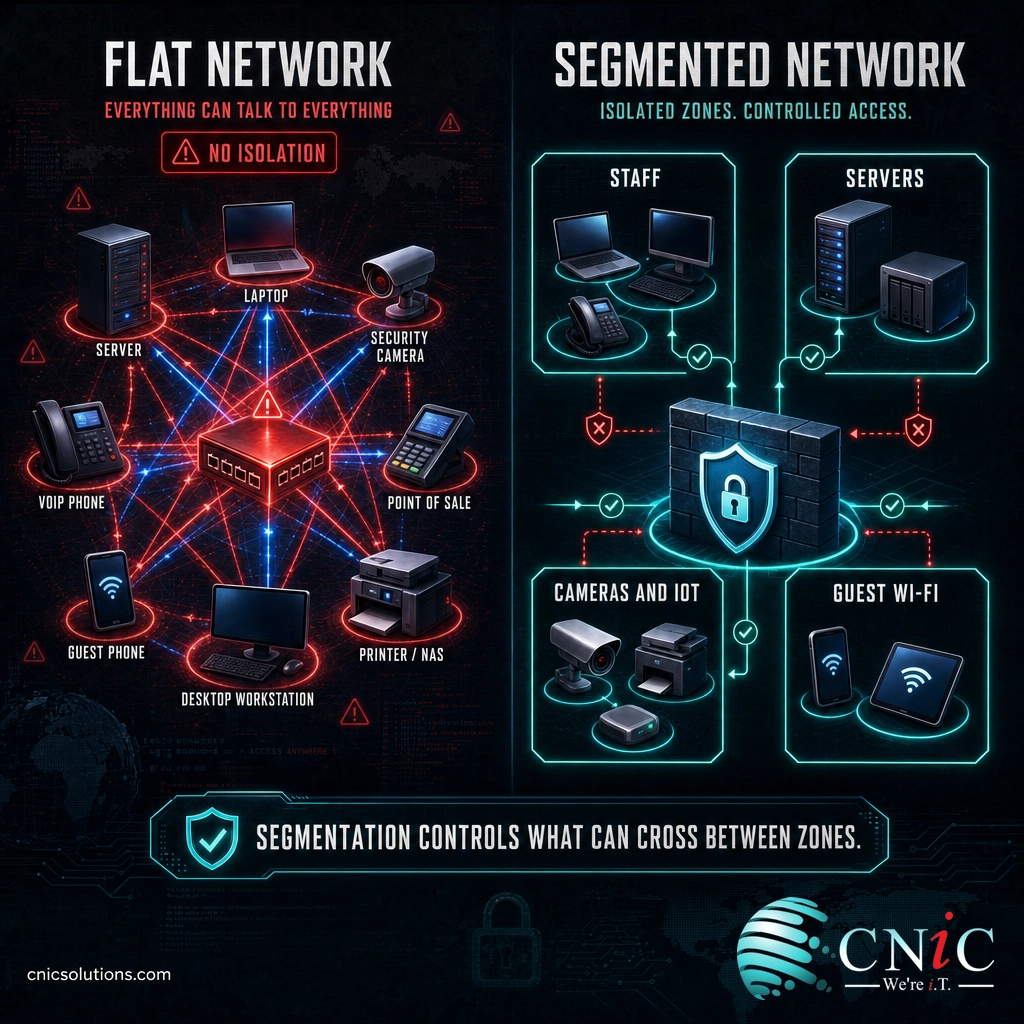
Most small business networks start out flat: every laptop, phone, camera, server, and guest device shares one open space where anything can reach anything else. It is simple to set up and quietly dangerous, because the moment one device is compromised, the intruder can move sideways to everything else. Network segmentation breaks that flat network into separate, controlled zones so a problem stays boxed into one area instead of spreading across the company. This guide explains what segmentation is, how it works, where VLANs and microsegmentation fit, and how to roll it out without over-engineering it.
- Segmentation is about containment. The goal is to shrink the blast radius, so a compromise or fault in one zone cannot spread to the rest of the network.
- It is a strategy, not a single product. VLANs, subnets, firewalls, and access rules are the tools; segmentation is the plan that uses them together.
- VLANs are the most common way to do it. Virtual LANs create the isolated zones on equipment you already own, with no new cabling.
- Microsegmentation goes further. It isolates individual workloads or servers and is a building block of a zero trust security model.
- It directly supports compliance. Segmenting card data, patient records, or other regulated systems reduces both your risk and the scope of frameworks like PCI DSS.
- It is high value for the cost. Most segmentation runs on switches and firewalls you already have, which is why it is one of the best security returns a small business can make.
Think of your network as an office building. A flat network is one giant open room where everyone, including visitors, can walk up to any desk, filing cabinet, or server. Segmentation adds interior walls and locked doors: reception and guests stay in the lobby, accounting has its own room, the server room has a badge reader, and the cameras sit on their own floor. Nobody moves between rooms unless a door is deliberately opened for them. Nothing about the building changed physically. You just decided who is allowed where, and now a stranger who slips into the lobby cannot wander into the vault.
What’s in This Guide
How Network Segmentation Works
Segmentation works by grouping devices into zones and then deciding, on purpose, what traffic is allowed to cross between those zones. On a flat network, that decision is never made: everything can reach everything by default. Segmentation replaces “allow everything” with “allow only what the business actually needs.”
In practice, most business segmentation is built from a small set of tools working together:
- Decide your zones. Group devices by role and sensitivity: staff computers, servers, VoIP phones, security cameras, point-of-sale terminals, and guest Wi-Fi. Each becomes a candidate for its own segment.
- Create the segments. The most common way to separate zones on the equipment you already own is with virtual LANs (VLANs), which divide a physical switch into several logical networks without new cabling.
- Give each segment its own addressing. Each zone typically gets its own IP range through subnetting, so a VLAN and a subnet usually line up one to one.
- Enforce the boundaries. A router, Layer 3 switch, or firewall sits between the zones and applies rules deciding what may pass. This is where the actual security lives, because separation without enforcement is easy to bypass.
- Monitor and adjust. Traffic between segments is logged and reviewed, so unusual crossings stand out and rules can be tightened as the business changes.
The important shift is from physical to logical thinking. You are no longer grouping devices by which cable they plug into or which floor they sit on. You are grouping them by what they do and how much they should be trusted, then letting software enforce those groups. That is why segmentation scales so well on networks you already have: it is a design decision applied to existing hardware, not a hardware purchase.
Segmentation also comes in two broad strengths. Coarse segmentation separates large zones, such as putting all guest traffic on one segment away from internal systems. Fine-grained segmentation isolates much smaller units, down to a single application or server, which is where microsegmentation comes in. Both follow the same principle: only necessary traffic crosses a boundary, and everything else is blocked by default.
Source: NIST Special Publication 800-207, Zero Trust Architecture
Segmentation vs. Microsegmentation
The term people most often confuse with network segmentation is microsegmentation. They sound like the same thing at different sizes, and in a sense they are, but the distinction matters when you plan a rollout. Traditional segmentation works at the level of network zones. Microsegmentation works at the level of individual workloads.
Classic segmentation draws boundaries around groups of devices: a finance segment, a guest segment, a camera segment. Traffic is controlled as it moves between those zones, usually at a firewall or router. Microsegmentation goes inside the zone and controls traffic between individual servers or applications, even when they sit on the same segment. It assumes that being “inside” the network is not enough to be trusted, which is the core idea of a zero trust architecture as defined by the National Institute of Standards and Technology.
| Factor | Network Segmentation | Microsegmentation |
|---|---|---|
| Scope of isolation | Broad network zones (departments, device types) | Individual workloads, servers, or applications |
| Typical tools | VLANs, subnets, firewalls, access control lists | Host-based policy, software-defined controls, identity rules |
| Where control happens | At the boundary between zones | Between individual systems, even in the same zone |
| Best for | Separating guests, cameras, and departments | Protecting critical servers and data center workloads |
| Underlying model | Trust within a zone, control at the edges | Zero trust: verify every connection |
For most small and midsize businesses, the right starting point is straightforward zone-based segmentation. It delivers the biggest security gain for the least complexity. Microsegmentation earns its place later, usually around sensitive servers, regulated data, or specific high-value systems, once the basic zones are in place and working.
Myth: “We have a firewall, so our network is already segmented.” A perimeter firewall protects the boundary between your network and the internet, but it does nothing about traffic moving inside your network. If everything behind that firewall sits on one flat network, an attacker who gets past the edge, or a laptop that walks in already infected, can still reach everything. Real segmentation controls internal traffic between zones, not just the front door. The firewall is one enforcement point, not the whole strategy.
Source: NIST SP 800-207, Zero Trust Architecture
Why Network Segmentation Matters for Your Business
Segmentation is easy to dismiss as an IT detail, but the reason it matters is entirely about money and risk. When an intruder or a piece of ransomware lands on a flat network, the expensive part is not the first machine it touches. It is the lateral movement to everything else. Segmentation is one of the most direct ways to stop that spread, which is exactly why the Cybersecurity and Infrastructure Security Agency recommends it as a frontline defense against ransomware.
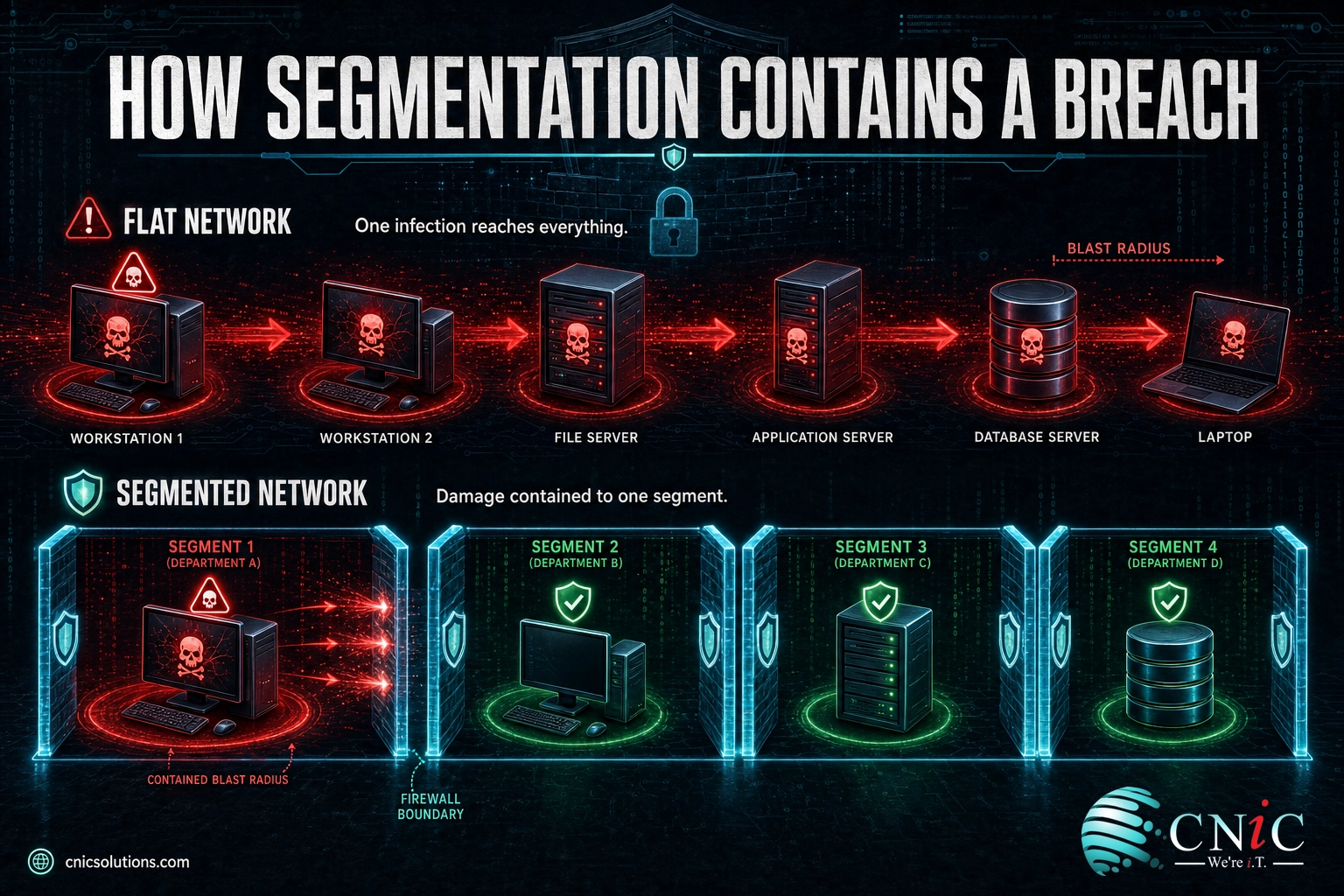
The cost of failing to contain an incident is well documented. IBM’s Cost of a Data Breach report put the global average cost of a breach at 4.88 million dollars in 2024, and found that breaches took an average of 258 days to identify and contain. Much of that damage accumulates while an attacker moves freely across an unsegmented network, reaching more systems the longer they go undetected.
There is a downtime side to this as well. A network that is one big undivided space is harder to troubleshoot, and a fault or infection in one place can knock out the whole business at once. That is expensive: ITIC’s 2024 survey found a single hour of downtime now costs more than 300,000 dollars for over 90 percent of midsize and large enterprises. A segmented network contains a fault to one zone instead of letting it take everything down together, and it makes problems far faster to isolate and fix.
Finally, segmentation is often a compliance lever, not just a security one. The PCI Security Standards Council recommends isolating systems that store or process payment card data so the sensitive environment is separated from the rest of the network, which reduces both risk and the scope of a PCI DSS assessment. The same logic applies to healthcare: isolating systems that hold protected health information supports HIPAA safeguards and limits how much is exposed if something goes wrong. For a regulated small business, a clean segmentation design can lower audit burden and breach exposure at the same time.
Source: IBM Cost of a Data Breach 2024 | ITIC 2024 Hourly Cost of Downtime | CISA ransomware guidance on segmentation

Types of Network Segmentation
“Segmentation” covers several approaches that are often combined. Knowing the names helps you follow any design conversation and decide what your own network needs.
1Physical segmentation
The oldest form: genuinely separate hardware for separate networks, with their own switches and cabling. It offers strong isolation but is expensive to build and maintain, so it is usually reserved for the most sensitive or regulated systems where nothing else is acceptable.
2Logical (VLAN-based) segmentation
The workhorse of business networks. Instead of buying separate hardware, you divide the switches you already own into isolated zones with VLANs. It delivers most of the benefit of physical separation at a fraction of the cost, which is why it is the default approach for the majority of small and midsize networks.
3Firewall and access-control segmentation
Zones are only as isolated as the rules between them. Internal firewalls, Layer 3 switches, and access control lists decide which traffic may cross from one segment to another. This is the enforcement layer, and it is where segmentation either works or quietly fails.
4Microsegmentation
The finest-grained approach, isolating individual servers, applications, or workloads rather than whole zones. It is central to zero trust designs and is most valuable around critical systems, databases, and regulated data.
Alongside these approaches, a few segments show up in almost every well-designed business network. Knowing them makes it easier to see where to start.
| Common segment | Why it gets isolated |
|---|---|
| Guest Wi-Fi | Visitors reach the internet but nothing internal, so an unknown device never touches business systems. |
| Security cameras and IoT | Cameras, sensors, and smart devices are frequently insecure, so they are kept off the network that holds real data. |
| VoIP phones | A voice segment protects call quality from data traffic and keeps phones separate from computers. |
| Point-of-sale and payment | Card-handling systems are isolated to reduce risk and shrink the scope of PCI DSS requirements. |
| Servers and sensitive data | Finance, HR, and core servers are separated from general staff traffic and higher-risk zones. |
You do not build all of these at once. Most businesses start with the two segments that pay off immediately, guest Wi-Fi and cameras or IoT, and expand from there as the network matures.
How to Get Started with Network Segmentation
Segmentation is best done deliberately, in a sensible order, rather than all at once. A workable rollout for a small or midsize business looks like this:
- Inventory what is on the network. List every device and group it by function and sensitivity: staff computers, servers, phones, cameras, point-of-sale, and guest devices. You cannot segment what you have not mapped. A broader walkthrough of this step lives in our guide to setting up a small business network.
- Pick your first zones. Start with the highest-value, lowest-effort wins. Guest Wi-Fi and cameras or IoT on their own segments almost always come first, because the security payoff is immediate and the risk of disruption is low.
- Build the segments. Create the VLANs, assign matching subnets, and configure switch ports so each zone is cleanly separated on the hardware you already run.
- Write the rules between zones. Use a firewall, Layer 3 switch, or access control lists to allow only the traffic the business genuinely needs to cross between segments. Everything else is blocked by default.
- Test, monitor, and document. Confirm each segment can reach what it should and nothing it should not, then log traffic between zones and write the design down so it survives staff changes.
The step where segmentation most often goes wrong is enforcement. A too-permissive rule between zones, or a misconfigured trunk, can quietly undo the isolation you built and leave you believing you are protected when you are not. Because the security depends entirely on getting those boundaries right, this is a common point to bring in help. If you would rather have segmentation designed and enforced correctly from the start, our team designs and configures business networks and manages that infrastructure end to end, segmentation included.
Get a Free Security Audit of Your Network
Talk to Our Network Engineers
Common Questions About Network Segmentation
What is network segmentation in simple terms?
What is the difference between network segmentation and a VLAN?
What is microsegmentation?
Does network segmentation help with PCI or HIPAA compliance?
Does a small business really need network segmentation?
Related Networking Terms
- VLAN (virtual LAN): The most common tool for building segments, dividing one physical switch into several isolated logical networks.
- Subnet: A Layer 3 range of IP addresses, usually mapped one to one with a segment so each zone gets its own addressing.
- Microsegmentation: Isolation at the level of individual workloads or servers, a building block of zero trust security.
- Zero trust: A security model that trusts no device by default and verifies every connection, whether inside or outside the network.
- Lateral movement: How an attacker spreads from one compromised device to others; segmentation exists largely to stop it.
- LAN vs. WAN: The difference between the network inside one location and the connections that link locations across distance.
- Managed firewall: The service that enforces the rules deciding which traffic is allowed to cross between your segments.
About This Guide
This explainer relies on primary standards and authoritative sources rather than secondary write-ups. The zero trust and microsegmentation framework references NIST Special Publication 800-207. Segmentation as a defense against ransomware and lateral movement follows guidance from CISA. Payment-data scoping guidance references the PCI Security Standards Council. Breach cost and lifecycle figures come from IBM’s Cost of a Data Breach 2024 report, and downtime cost figures come from the ITIC 2024 Hourly Cost of Downtime survey. CNiC Solutions is a Houston-based managed IT, networking, and cybersecurity provider; this article is educational and not a substitute for a network assessment of your specific environment.
Sources:
NIST SP 800-207, Zero Trust Architecture |
CISA: Ransomware Guidance and Segmentation |
PCI Security Standards Council |
IBM Cost of a Data Breach 2024 |
ITIC 2024 Hourly Cost of Downtime
Get a Free Consultation on Your Network Security



related posts
What Is Network Penetration Testing? Types and Process
October 25, 2026Network penetration testing is a controlled, authorized simulation of a real cyberattack on your network, run…
What Is NIST Compliance? Frameworks, Requirements, and Who Needs It
October 25, 2026NIST compliance means aligning your organization's security program with the cybersecurity standards published by the National…
What Is MFA? How Multi-Factor Authentication Protects Your Accounts
October 24, 2026Multi-factor authentication (MFA) is a security method that requires two or more separate proofs of identity…
What Is Mobile Device Management (MDM)? A Guide for Businesses
October 24, 2026Mobile Device Management (MDM) is software that lets an organization remotely enroll, configure, secure, and monitor…