

Hardware as a Service (HaaS) is a procurement model in which a business subscribes to the IT hardware it needs, computers, servers, and network gear, from a managed service provider instead of buying it outright. The provider owns, installs, maintains, and eventually replaces the equipment for a predictable recurring fee.
For decades, getting the technology a business runs on meant buying it: a big capital purchase, a depreciating asset on the books, and a support headache whenever something broke or aged out. Hardware as a Service flips that arrangement. Instead of owning equipment, you subscribe to it, and the provider takes on ownership, upkeep, and the whole refresh cycle. This guide explains what HaaS actually is, how it works, how it differs from buying and from leasing (the distinction that confuses most people), what a good agreement includes, the benefits and the honest trade-offs, and how to tell whether it fits your business.
Key Takeaways
- HaaS is a subscription for hardware, not a purchase. You pay to use the equipment; the provider owns it.
- It bundles the full lifecycle: installation, monitoring, maintenance, upgrades, support, and end-of-life replacement, all defined in a service level agreement.
- It is not the same as leasing. A lease finances the hardware; HaaS manages it for you as well.
- It shifts CapEx to OpEx, removing the large upfront cost and making budgeting predictable.
- It fits some situations better than others. The value depends on how fast your technology changes and how much you can manage in-house.
What’s in This Guide
What Hardware as a Service Is
Hardware as a Service is a procurement model, closer in spirit to a subscription than to a sale. Rather than buying laptops, servers, switches, or phones and owning them, a business pays a recurring fee to use that hardware, and a provider (usually a managed service provider, or MSP) owns the equipment and stands behind it. As IBM’s overview of the hardware-as-a-service model puts it, the customer primarily pays for the use of the hardware rather than the hardware itself, and the provider retains responsibility for the full equipment lifecycle: performance, upgrades, and eventual disposal.
That last part is what separates HaaS from just buying gear on a payment plan. The provider does not just hand over a box. It monitors the equipment, keeps it patched and current, repairs or replaces it when it fails, and swaps it out when it ages. In effect, HaaS takes hardware, historically a thing you owned and had to babysit, and turns it into a managed service with a single predictable bill. It is the same “as a service” logic that reshaped software and infrastructure, applied to the physical devices on desks and in server rooms.
It also marks a move away from the old break-fix approach, where a business bought its own equipment and called for help only after something failed. For a fuller picture of that contrast, see our explainer on what break-fix IT is and why businesses moved on from it. HaaS pairs the hardware with proactive, ongoing management from day one.
How HaaS Works
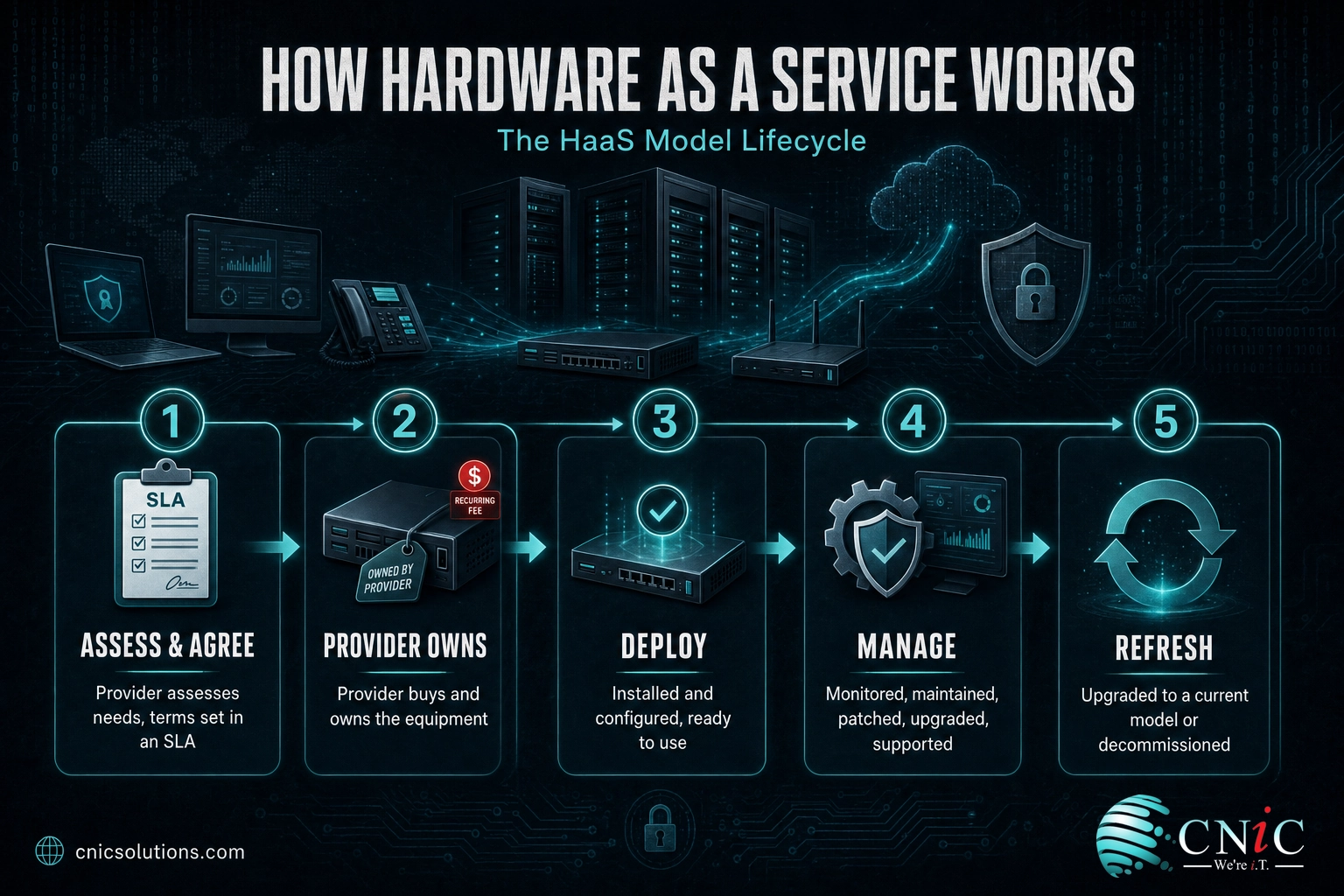
Behind the single monthly invoice, a HaaS arrangement usually runs through a predictable sequence:
- Assessment and agreement. The provider assesses what your business needs, recommends the right equipment, and the terms are captured in a service level agreement (SLA) that spells out who is responsible for what.
- Procurement and ownership. The provider buys the hardware and retains ownership of it. That is what removes the capital purchase from your side of the table.
- Deployment and configuration. The equipment is installed, configured, and integrated into your environment, ready to use rather than delivered in a carton.
- Ongoing management. Throughout the term, the provider monitors, maintains, patches, upgrades, and supports the hardware, and repairs or replaces any unit that fails, typically within the response times promised in the SLA.
- Refresh or decommission. At the end of the agreement, the provider refreshes the equipment to a current model or decommissions it properly, including securely wiping data and recycling the device.
The pricing that sits on top of this can take several forms. A flat monthly subscription per device or per user is the most common, but agreements can also be built around usage duration, telemetry from the equipment, or specific service tiers. The through-line is that you pay to use and be supported, not to own.
HaaS vs Buying vs Leasing
HaaS is easy to confuse with the two arrangements it sits between: buying hardware outright and leasing it. They differ in who owns the equipment, who maintains it, and how the cost lands on your books.
| Buy (own it) | Lease (finance it) | HaaS (subscribe to it) | |
|---|---|---|---|
| Upfront cost | High (full purchase) | Low to none | Low to none |
| Who owns the hardware | You | The lessor (finance company) | The provider (MSP) |
| Who maintains and supports it | You | You | The provider |
| Upgrades and refresh | Your problem, when you fund it | Your problem | Built into the service |
| Accounting treatment | Capital expense (CapEx) | Often financed / CapEx-like | Operating expense (OpEx) |
| End of life | You dispose of it | Return the equipment | Provider refreshes or decommissions |
The single most common misunderstanding is treating HaaS as a rebranded lease. A lease is fundamentally a financing tool: it spreads the cost of equipment over time, but you are still the one who sets it up, keeps it running, fixes it, and eventually replaces it. HaaS wraps all of that management into the arrangement. Put another way, leasing finances the hardware; HaaS manages it for you. That is why HaaS is usually delivered by a managed service provider rather than a finance company, the value is in the ongoing service, not just the payment terms.
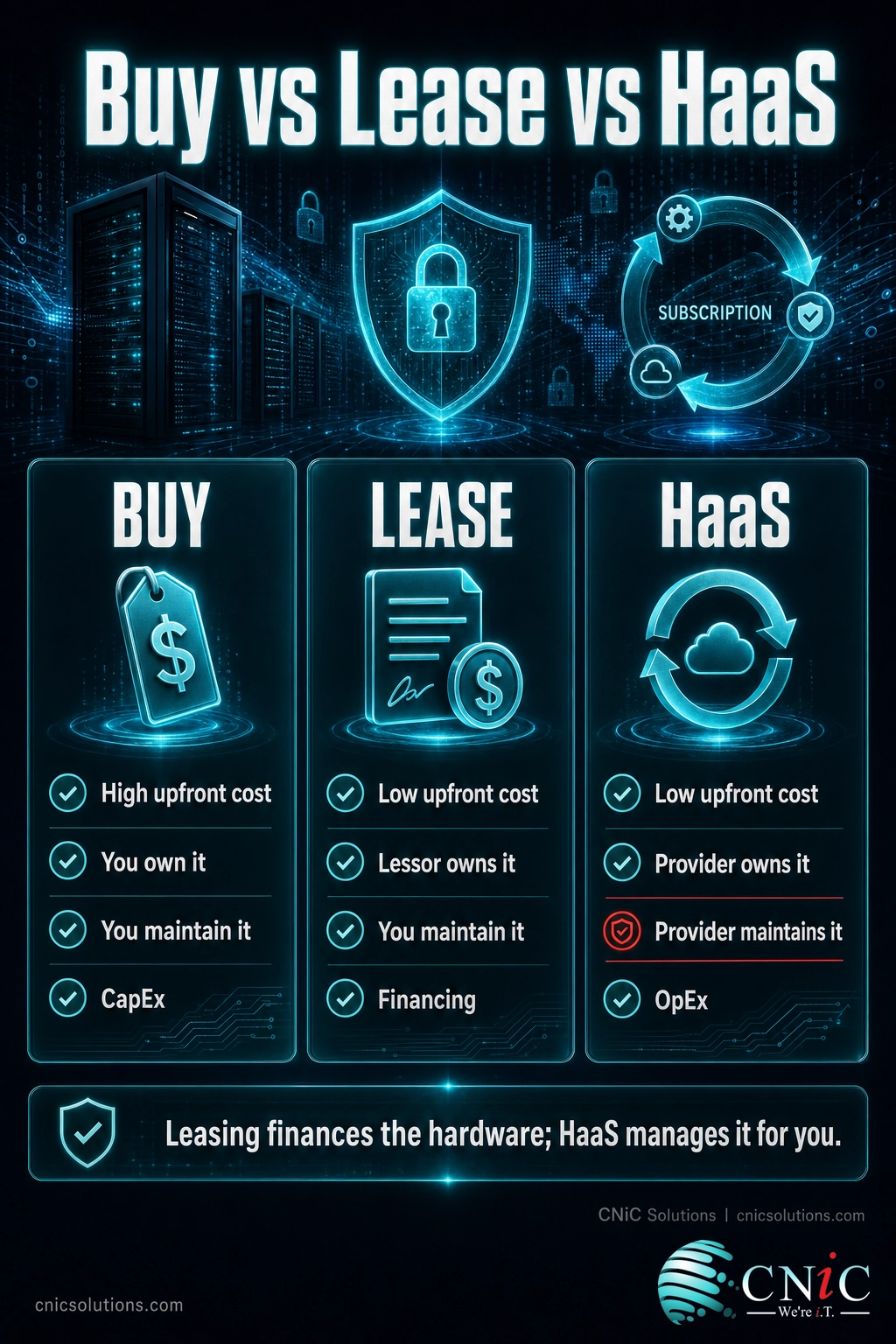
Because the two models are structured so differently, they also show up differently in your financial planning. Buying and, in many cases, leasing behave like capital investments; HaaS behaves like an operating cost, which is part of the reason the decision often gets weighed alongside broader questions of in-house versus outsourced IT costs.

What HaaS Typically Includes
The defining feature of HaaS is that the hardware never arrives alone. A well-structured agreement bundles the equipment with the services that keep it useful over its whole life:
- The hardware itself, specified and sourced by the provider to match your needs.
- Installation and configuration, so the equipment is deployed and integrated rather than dropped on your doorstep.
- Monitoring and maintenance, keeping devices healthy, patched, and secure.
- Upgrades and firmware updates, so the equipment stays current instead of quietly falling behind.
- Warranty, repair, and replacement, handled by the provider when something fails, within agreed response times.
- End-of-life decommissioning, including secure data destruction and responsible recycling.
Exactly which of these are included, and to what standard, lives in the SLA. That document is where a strong HaaS agreement is separated from a weak one: response times, what counts as a covered failure, how often equipment is refreshed, what happens if you end the contract early, and how data is handled at end of term. Read it the way you would read an insurance policy, because in practice that is part of what it is.
Types of Hardware You Can Get as HaaS
HaaS is a model, not a single product, so it applies across most categories of business technology. Some of the same idea also travels under more specific names.
- Endpoints: laptops, desktops, and tablets for staff. When a provider bundles the full management of these user devices, it is often marketed as Device as a Service (DaaS).
- Servers and infrastructure: physical servers, storage, and the supporting equipment in a server room or closet, delivered and maintained as a service rather than bought and racked by you.
- Networking equipment: routers, switches, firewalls, and wireless access points. Delivered as an ongoing managed subscription, this overlaps with Network as a Service (NaaS).
- Peripherals and specialized devices: printers and multifunction devices, VoIP phones, security cameras, and point-of-sale hardware, each of which can be provided and supported under the same subscription logic.
In practice, many businesses do not adopt HaaS one device at a time. They fold hardware into a broader managed IT relationship, where endpoints, network, and support are handled together, and hardware refresh becomes one more thing the provider plans and executes rather than a scramble every few years.
Benefits and Trade-Offs
HaaS earns its place for real reasons, but a clear-eyed look at both sides is the only honest way to decide.
The benefits:
- No large upfront purchase. The capital cost of equipping or re-equipping a business goes away, freeing up cash for other priorities.
- CapEx becomes OpEx. Hardware shifts from a lumpy capital investment to a steady operating expense, which makes budgeting more predictable and ties directly into how a business plans its annual IT budget.
- Always-current technology. Because refresh is built in, you are far less likely to be running equipment that is out of warranty, out of support, or too slow for the work.
- Support and lifecycle are handled. Monitoring, maintenance, security patching, repair, and disposal come with the service, which lifts a real burden off an internal team, or fills the gap when there isn’t one.
- Scalability. Adding seats as you grow, or trimming them when you contract, is a change to the subscription rather than a fresh procurement project each time.
The trade-offs:
- Long-run cost. For hardware that is stable and long-lived, the total paid over many years of subscription can exceed what buying once would have cost. HaaS trades some raw efficiency for predictability, currency, and service.
- You don’t build an asset. You never own the equipment, so it never becomes something you can keep running past its term at no marginal cost.
- Provider dependence. You are relying on the provider to deliver support and refresh as promised, which is exactly why the SLA and the provider’s track record matter so much.
Myth: “HaaS is just leasing with a new name.” It isn’t. A lease is a financing arrangement, once you have the equipment, setup, maintenance, upgrades, and support are still on you. HaaS bundles that ongoing management into the service, which is the whole point and the main thing to verify in the contract. If a “HaaS” offer is really just financing with no meaningful service wrapped around it, treat it as a lease and price it accordingly.

Does Your Business Need HaaS?
HaaS is not the right answer for everyone, and a good provider will tell you so. It tends to make sense when several of these are true:
- You want current technology without tying up cash in a large hardware purchase.
- You are growing, or your headcount and needs change often enough that fixed, owned equipment is awkward to size.
- Predictable monthly budgeting matters more to you than squeezing the lowest possible long-run cost out of hardware.
- Your internal team does not have the time or expertise to manage hardware lifecycles, patching, and refresh on top of everything else, or you have no internal IT at all.
- You are tired of running equipment until it fails and want proactive maintenance, support, and a planned refresh cycle instead.
- You want the hardware decision to be part of a coherent technology plan rather than a series of one-off purchases.
If most of that describes you, HaaS is worth a serious look. If instead you have hardware that rarely changes, a capable internal team, and a preference for owning assets outright, buying may still be the better economic call. The right choice comes down to your cost profile, how fast your technology moves, and how much you want to manage yourself.
CNiC Solutions helps small and midsize businesses make that call and, when it fits, delivers hardware as part of a fully managed IT relationship: the right equipment, deployed and supported, with lifecycle and refresh handled rather than left to chance. For businesses weighing where hardware fits inside a wider technology and budget strategy, our Virtual CIO services help align procurement decisions with overall business goals.
Talk to CNiC about managed IT and hardware for your business
Frequently Asked Questions
What is Hardware as a Service (HaaS)?
What is the difference between HaaS and leasing?
What does HaaS typically include?
Is HaaS cheaper than buying hardware?
What kinds of businesses use HaaS?
About This Guide and Sources
The definition and framework in this guide, HaaS as a procurement model, the provider’s ownership and full-lifecycle responsibility, the SLA-defined scope, the CapEx-to-OpEx shift, the range of subscription pricing structures, and the distinction between HaaS and leasing, reflect standard, widely consistent characterizations of the model, including definitions from IBM and TechTarget. HaaS agreements vary significantly by provider, equipment type, and service level; specific prices, refresh cadences, and contract terms are not cited here because they differ from one arrangement to the next and should be confirmed in the actual service level agreement. No cost, savings, or adoption statistics are quoted, as reliable primary figures specific to HaaS are not consistently established across sources.

related posts
IT Compliance for SMBs: The Complete Guide
August 8, 2026IT compliance for a small business is the work of meeting the legal, industry, and contractual…
IT Support Tiers Explained: Level 1, 2, and 3
August 8, 2026IT support tiers are a layered structure that routes each technical issue to the right level…
How to Build a Disaster Recovery Plan (Step-by-Step Template)
August 7, 2026A disaster recovery plan is the documented, tested playbook that gets your systems, applications, and data…
How to Create a Business Continuity Plan (Step by Step)
August 7, 2026A business continuity plan is the written playbook that keeps your company running when something goes…